Fluid Dynamics in Sociological Systems
Value as holonomy, power as non-commutativity — made runnable, visual, and falsifiable.
A research project applying the apparatus of fluid dynamics — continuum, flow, viscosity, turbulence, vorticity — to social systems: how value propagates, how collective movements crystallize or dissipate, and how power circulates within a relational field. A project of Serendip Commons Society. It complements the discrete-structural G³ toolchain by addressing the continuum aspect of social phenomena.
The one idea
Genuine relational value is non-possessive. It is the holonomy — the path-dependent residue of a closed loop — not a stock held at a point. Whatever in a relation reduces to a single scalar ordering (accumulation, ranking, priced exchange) is curl-free and generates nothing around a loop. Power is the non-commutativity of that holonomy: the fact that the order of acts changes the outcome.
The project builds the machinery to make those two sentences precise, computable, and testable against data — and ties them to an ethics in which the good is non-possessive circulation, power is ineliminable, and justice is the geometry of power rather than its removal.
The arc of the formalism
Each layer generates the next; the code follows the same chain.
fluid model            a first, failed field theory — but yields one exact theorem
      │  self-undermines (conserves what should be generated)
      ▼
symmetry pre-structure G  →  spontaneous breaking  G → H
      ▼
order-parameter space  M = G/H        subjects = topological defects  π_k(G/H)
      ▼
surplus = holonomy  P exp ∮ A         power = non-commutativity (iff H non-abelian)
      ▼
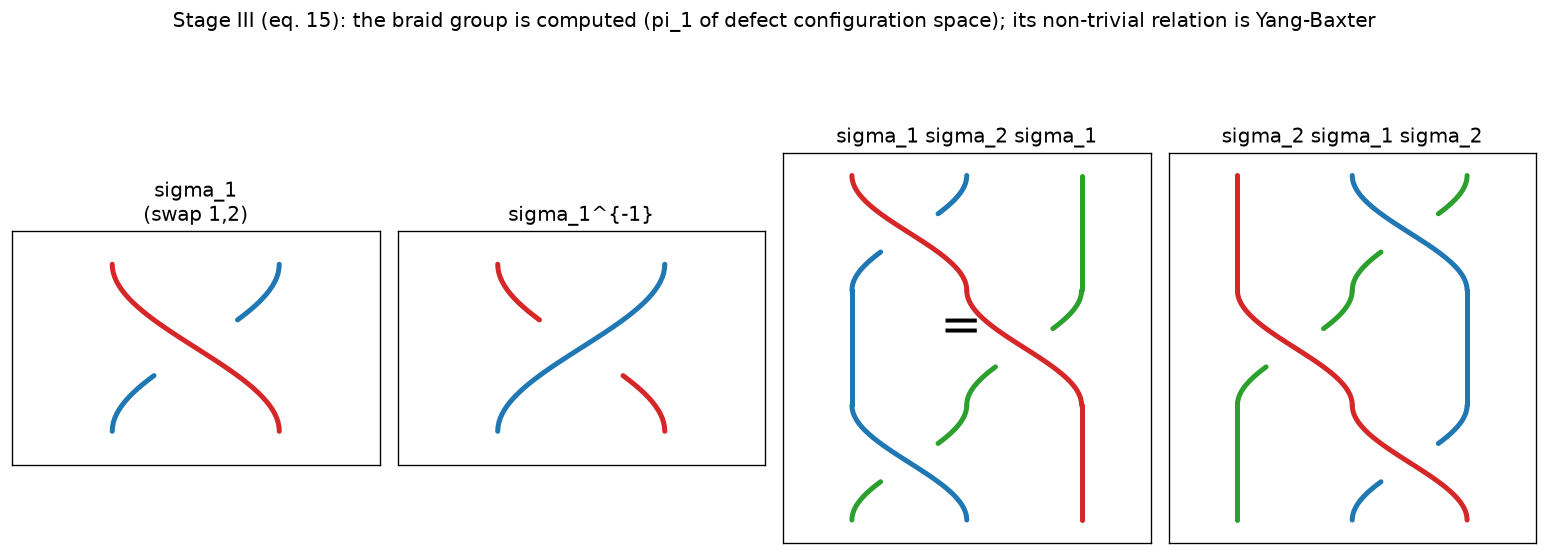
braid statistics  π₁(Cₙ(Σ)) = Bₙ(Σ)   non-abelian yet non-universal
      ▼
operationalization: sign(Θ), power 𝒞  — falsifiable, scale-invariant, tested on real classrooms
Part 1 — The dynamics
Every figure is produced by real computation, not drawn by hand.
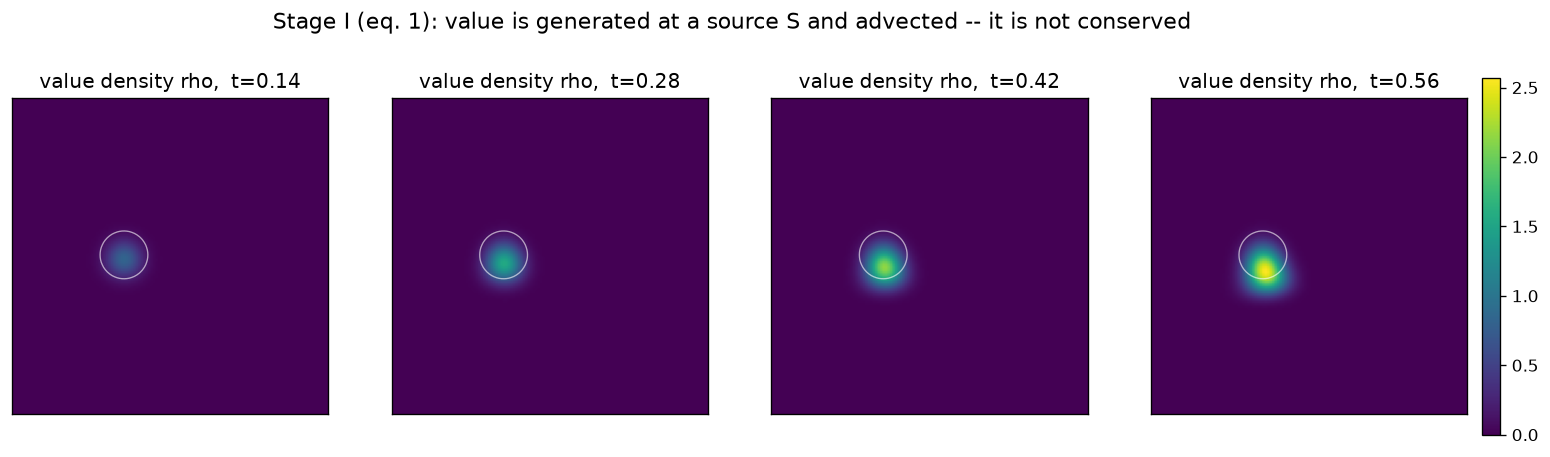
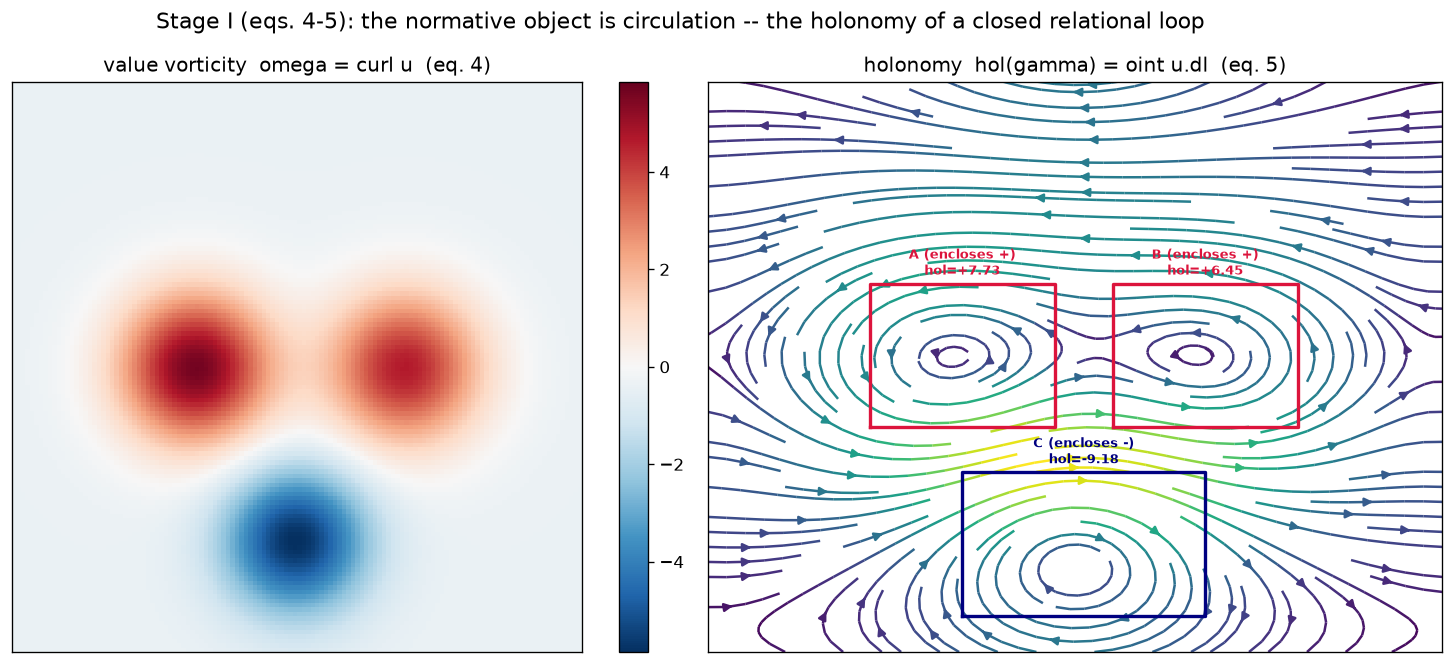
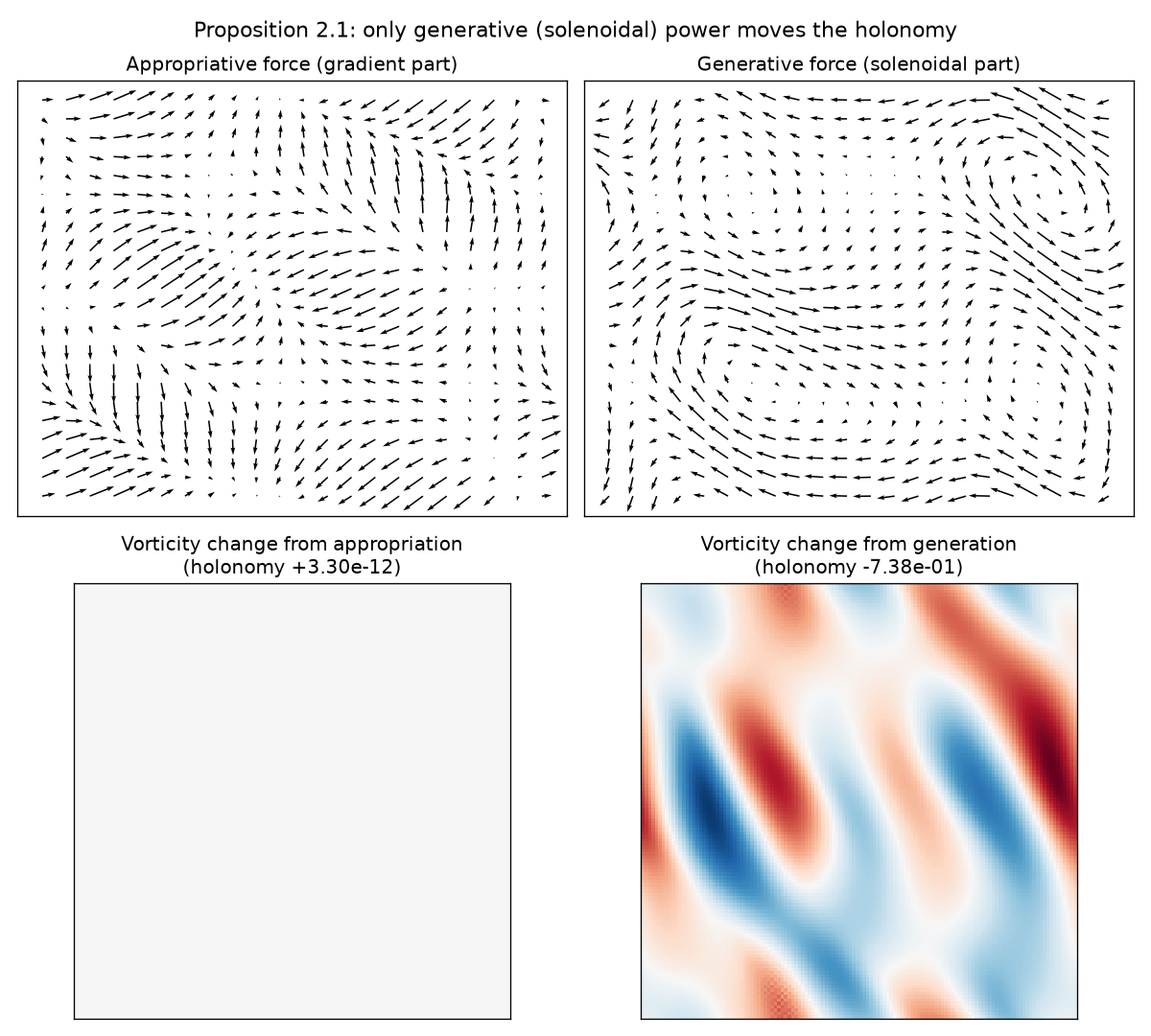
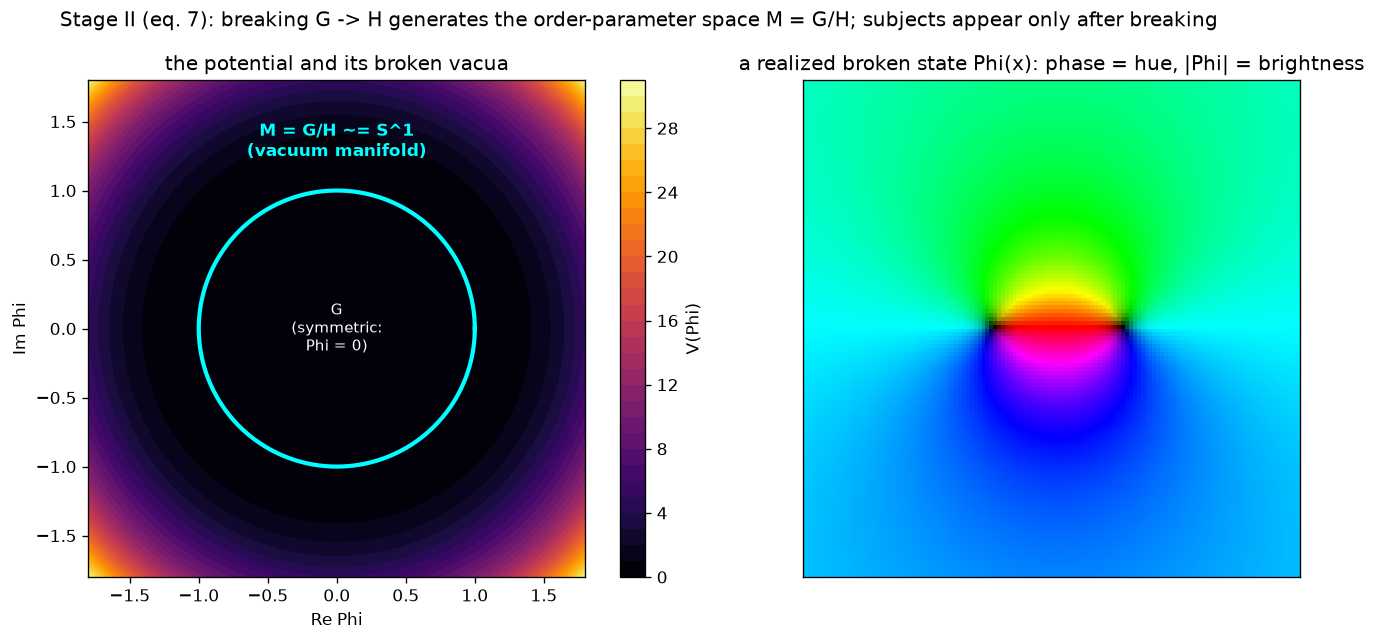
G → H — as topological defects of the vacuum manifold, not pre-given entities.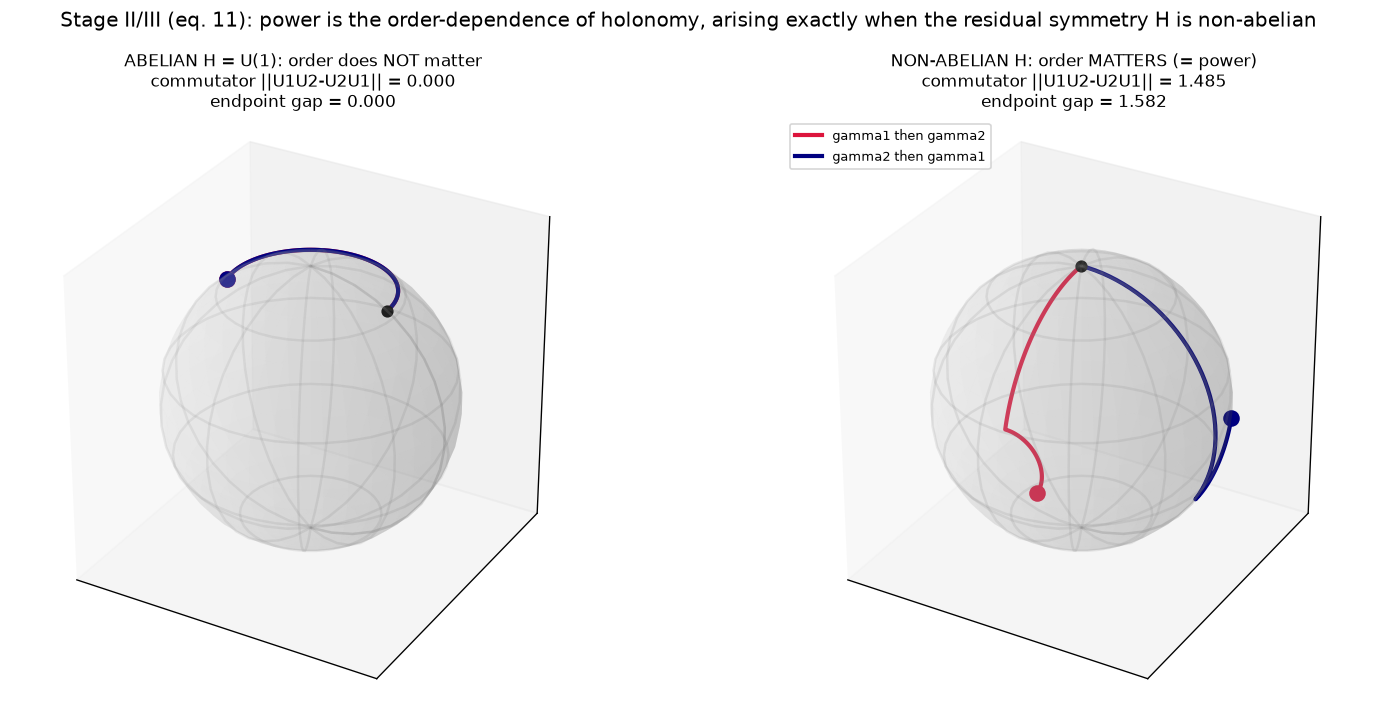
Part 2 — The ethics model
Read in a normative register, the dynamics are the ethics — bottom-up and relational, the good emerging from the structure of relational value rather than handed down from outside. Five claims:
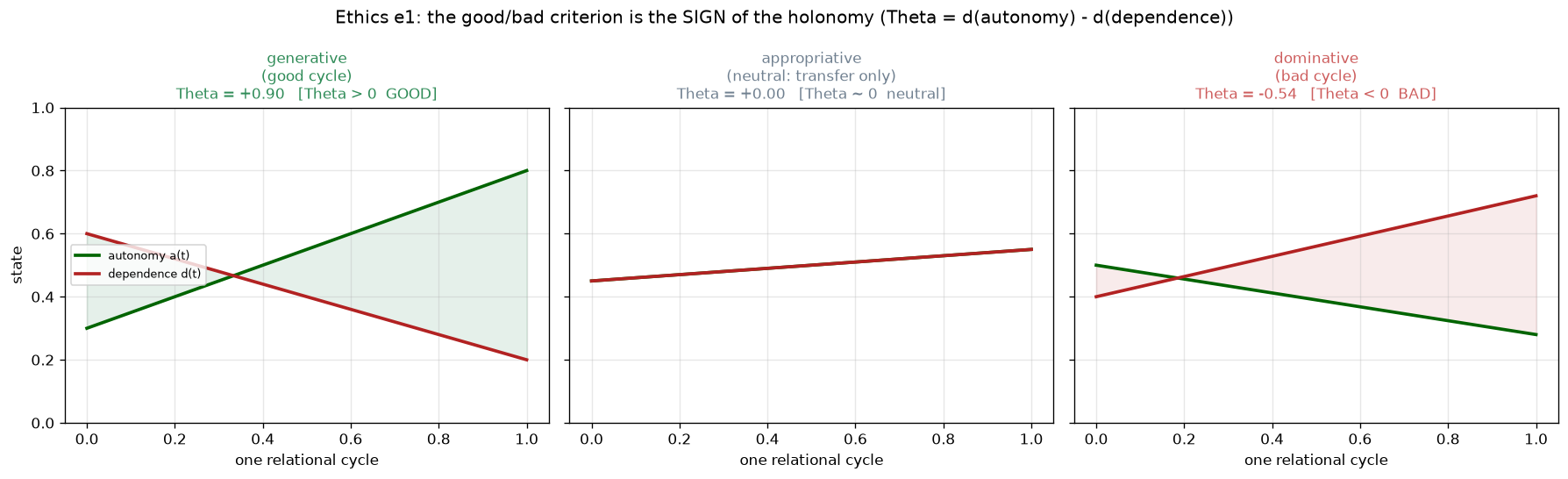
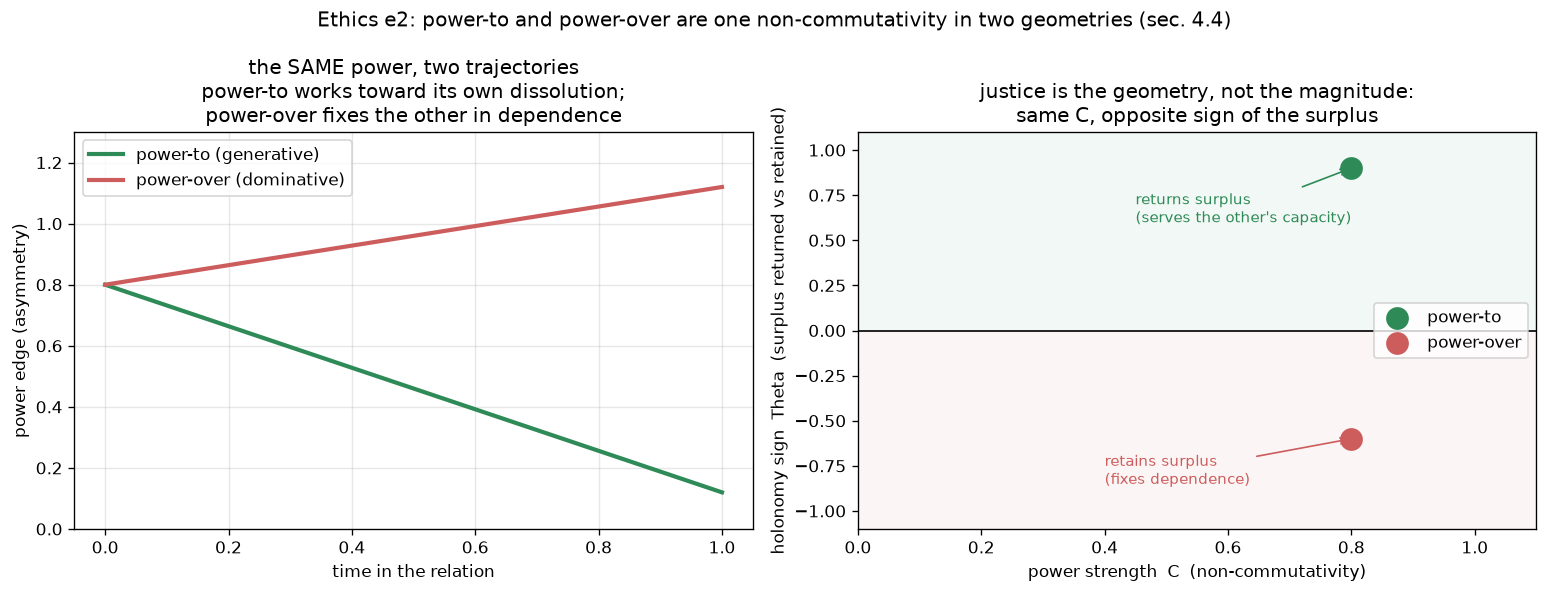
- The good is non-possessive circulation — a non-zero holonomy; value merely appropriated generates nothing.
- Power is ineliminable — power, resonance, and generativity are three faces of one non-abelian condition.
- Justice is the geometry of power, not its removal — shaping asymmetry to be generative (power-to) rather than dominative (power-over); the same non-commutativity, opposite sign of the holonomy.
- Injustice is solidification — the collapse of a living, circulating structure into a frozen, appropriative channel.
- Genuine vs forged deliberation — genuine deliberation is a positive-holonomy spiral; forged keeps the form while extracting value.
Part 3 — Real classrooms
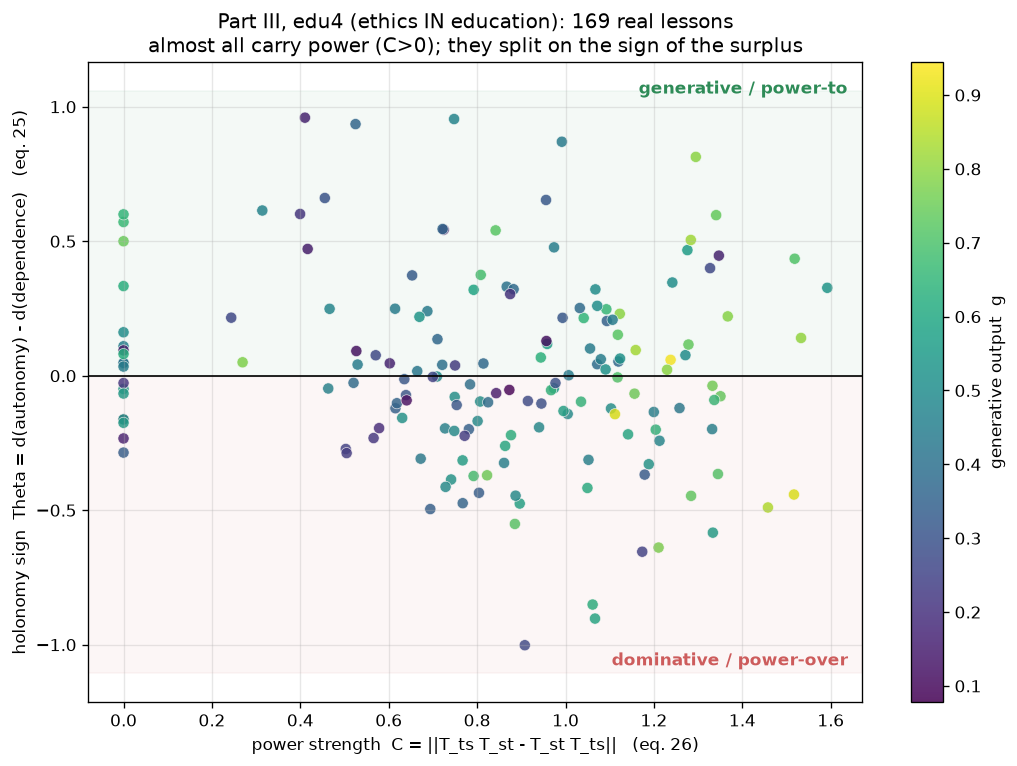
The instrument turned on real data: the TalkMoves corpus (169 K–12 mathematics lessons, CC BY-NC-SA 4.0). Two scale-invariant quantities are computed from the discourse — Θ (the sign of the holonomy: generative vs dominative) and 𝒞 (the strength of power, as the non-commutativity of turn-taking).
An honest instrument
Governance & licence
Approved by the Founder as SCS/PA/2026/04 (28 June 2026) under §14.4 of the Bylaws and classified under Domain I (Theoretical Infrastructure). Released under CC BY-NC-SA 4.0, © 2026 Serendip Commons Society — a deliberate non-commercial restriction (unlike the permissively-licensed G³), since careless commercial application of sociological-analytical methods could do harm without methodological caution.
Read the Project Approval (PDF)
⏱ The approval is blockchain-timestamped (OpenTimestamps): proof (.ots) · hash (.sha256). Verify with ots verify project_approval.pdf.ots.