
Generative Relational Academia
Infrastructure for recording how understanding changes.
Scholarly communication transmits finished artefacts and discards the trajectory that produced them — which assumption was abandoned, which objection forced the abandonment, which approach was tried for six months and set aside, which direction was chosen over which alternative and on what ground. GRA is a protocol, and a reference tool, for keeping that record.
The argument, in four steps
The case for recording trajectories is not that a fuller record is nicer to have. It is an argument about evidence, and it turns twice against itself before arriving anywhere.
The artefact is weakening as evidence.
A published artefact conveyed information about its producer's capacity only because producing it was costly in a way that discriminated between producers. The evidence was never in the object — it was in the difference between what the object cost different producers. Where that cost falls for producers of every capacity at once, the discrimination goes while the artefact, the practice, and the systems reading it all remain in place. The failure is invisible from inside the practice, because the artefacts continue to arrive and continue to be counted.
So the trajectory becomes a candidate — but it inherits the same problem.
Two hundred entries describing questions, attempts, failures and revisions, internally consistent and plausibly paced, are an easier object to fabricate than the paper they purport to have produced. Length, detail and the appearance of struggle are properties a fabricated record has as readily as a true one. Preserving a research process establishes nothing on its own.
Therefore credibility must come from distribution, not from content.
A transition registered by a party distinct from the one who proposed it is costly to fabricate in proportion to the number of parties who would have to participate in the fabrication. The precedent is old: the bound, paginated laboratory notebook countersigned by a witness who was not the inventor — evidential without disclosing its contents to anyone. This is why GRA is a protocol and not a platform: a platform operator is party to every entry and cannot supply the independence the record's credibility depends on.
And the binding constraint is capture cost, not representation.
Systems adequate to represent issues, positions, objections and evidence have existed since 1970 — IBIS, gIBIS, Compendium, design-rationale notations, scholarly claim ontologies — built by capable people with funding, connected to deployed standards. They were not adopted. The documented cause is that the work of recording fell on the party who gained least from the record, at the moment they could least bear it, in a form that served a different party later.
The first constraint on the design follows. Every act the protocol defines is one a participant performs for a reason of their own, with the record falling out of its performance. An act that exists so that a record should exist will not be performed, and any part of the design depending on such an act is moved to an optional tier or removed.
What is recorded
The unit is not a document, a comment, or an output. It is a transition: an identified prior state became an identified posterior state, through a typed act performed by a party and registered by a party.
state s_k  ──[ act: challenge · target: assumption · relation: modifies ]──▶  state s_k+1
                performer: A          registrar: B (distinct, signed)
                disposition: unresolved
A trajectory is the directed graph of these, and the “current state” is computed from the graph and never stored as an authority. This is what no existing system records: platforms that decompose a publication into typed linked units show that a second hypothesis exists; they do not show that this objection converted the first hypothesis into it. Commentary systems attach a remark to an artefact — nothing transitions, no state is superseded, and the relation between the comment and any later change lives only in the author's memory.
Five independent dimensions, not one flat list
Agreement between people classifying the same event declines as the number of categories rises, and a vocabulary requiring deliberation re-introduces the capture cost the whole design exists to avoid.
| Dimension | Values | Extensible? |
|---|---|---|
| act | question claim challenge transformation decision connection verification release | fixed by the protocol |
| target | question · assumption · hypothesis · concept · theory · method · path · artefact | by charter |
| relation | extends · modifies · replaces · refines · generalises · specialises · transfers | bound to CiTO |
| trigger | reflection · literature · experiment · simulation · observation · discussion · objection · failure · automated suggestion · entry of a new party | by charter |
| disposition | accepted · contested · unresolved | fixed by the protocol |
unresolved is not optional. Most objections in theoretical work are never resolved: they stand, and the work proceeds beside them. A vocabulary recording only acceptance and rejection would produce a systematically false record of the fields this project most concerns — and would exert pressure toward fabricated closure.Three planes, and what GRA contributes
Applications          search · matching · summarisation · visualisation · assessment
                      ── outside conformance. The protocol requires none of it. ──
        ▲
   TRANSITION PLANE   typed transitions · parent links · attestation + signature ·
                      attribution and absorption · disposition · disclosure class
                      APPEND-ONLY. The system of record.
        ▲  registration by a responsible party promotes an event to a transition
   EVENT PLANE        auto-generated records that something occurred: meetings,
                      comments, file changes, model operations.
                      PRIVATE TO PARTICIPANTS. Never exported, never indexed.
        ▼  delegation
   Substrates         version control · repositories and persistent identifiers ·
                      federation — existing, maintained by others, not reimplemented
The event plane is cheap to populate and carries no epistemic claim. It is also where the surveillance hazard falls: a complete log of who attended and whose files changed is a monitoring record by construction, so it is confined to participants and reaches wider disclosure only through a transition that references it. GRA contributes the transition plane and the rules governing promotion into it — and nothing else.
What it looks like
The images below are output from a real record — the philosophy case from the specification — captured from a running server, with the drawings emitted by the tool itself. Nothing here is a mock-up.
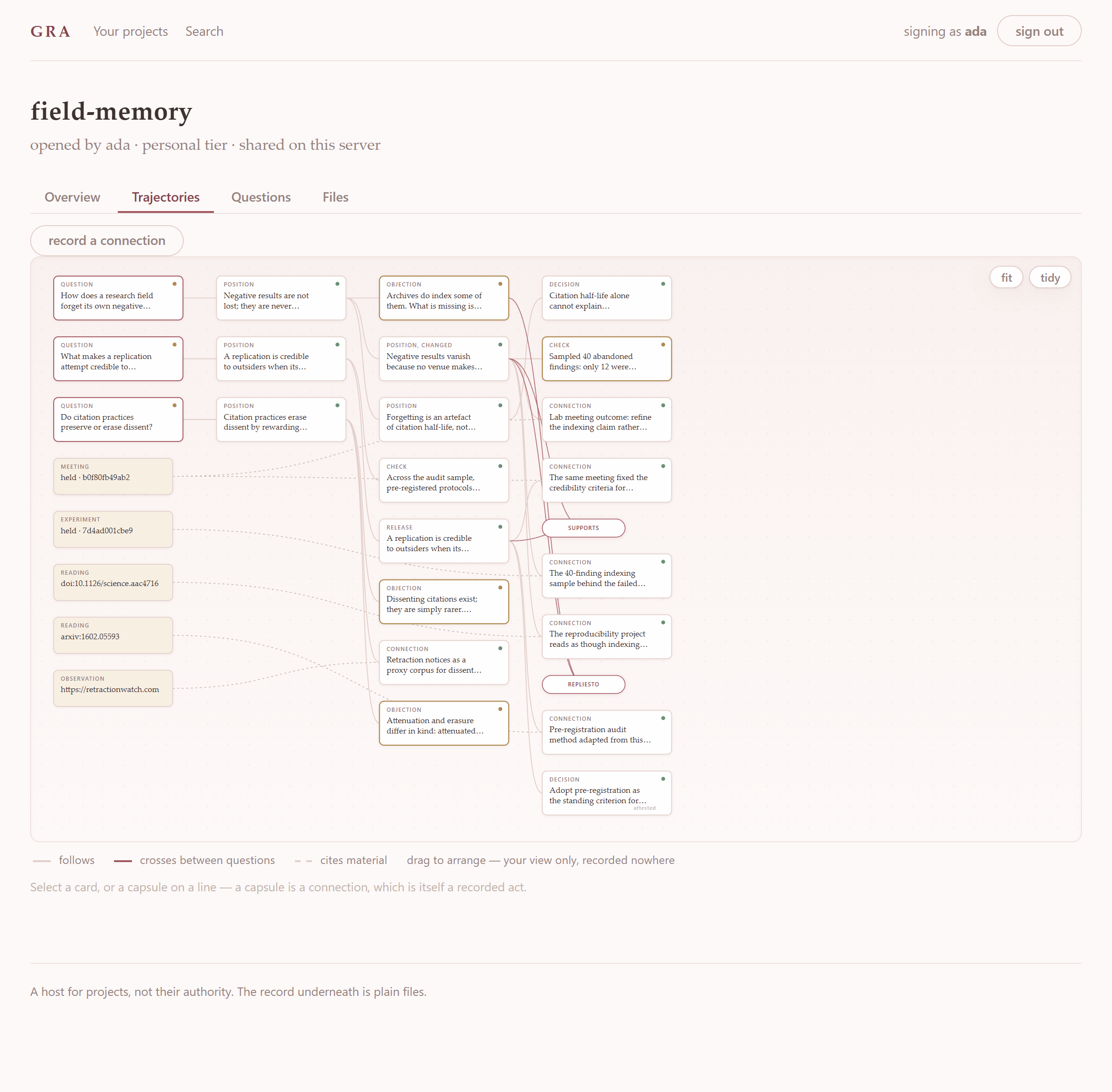
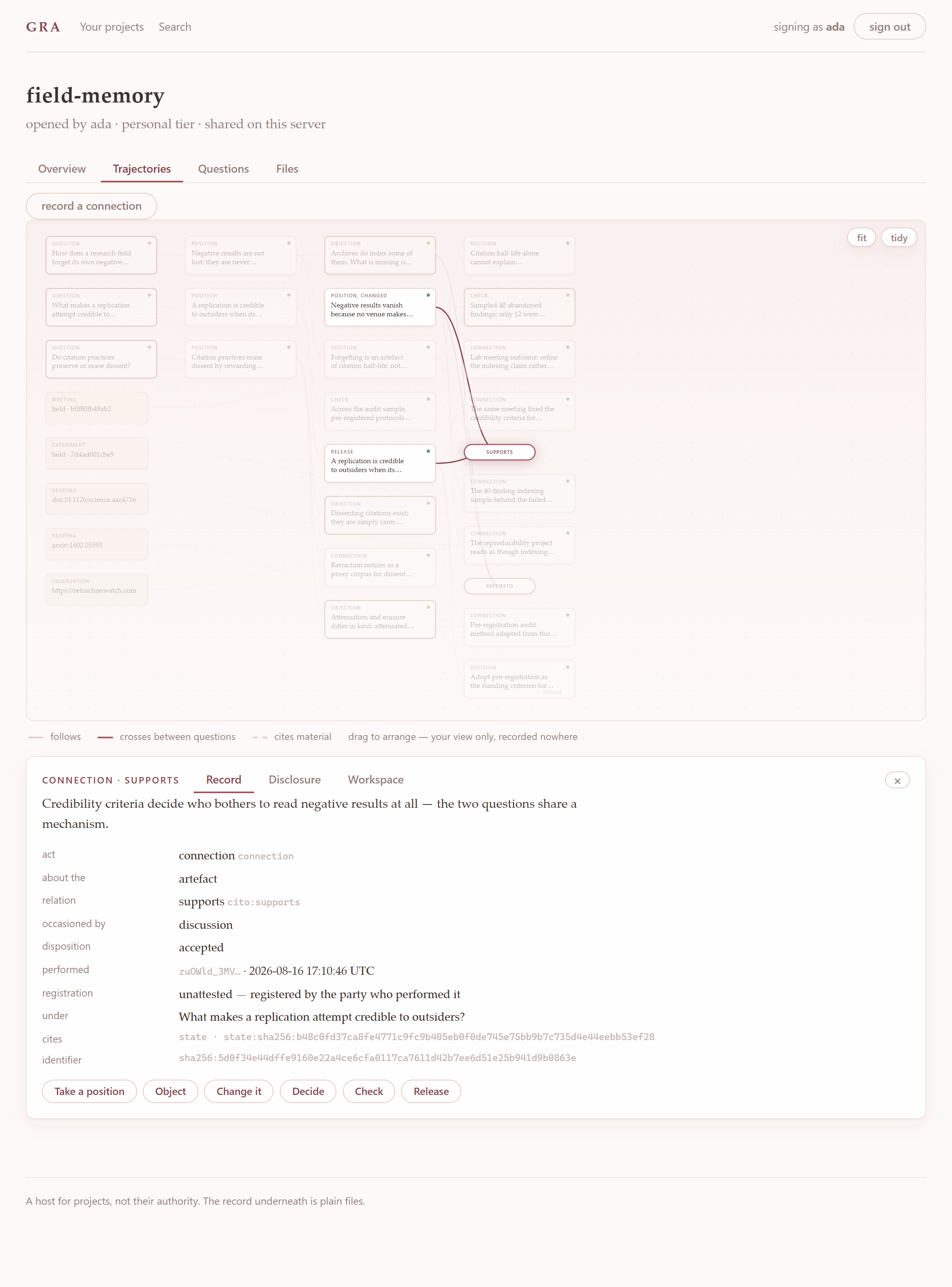
SUPPORTS edge between two questions, opened as a node with its signed payload, its CiTO binding, its registration and its disclosure panel. The acts row records against it through the reference tool, whose refusals are shown verbatim.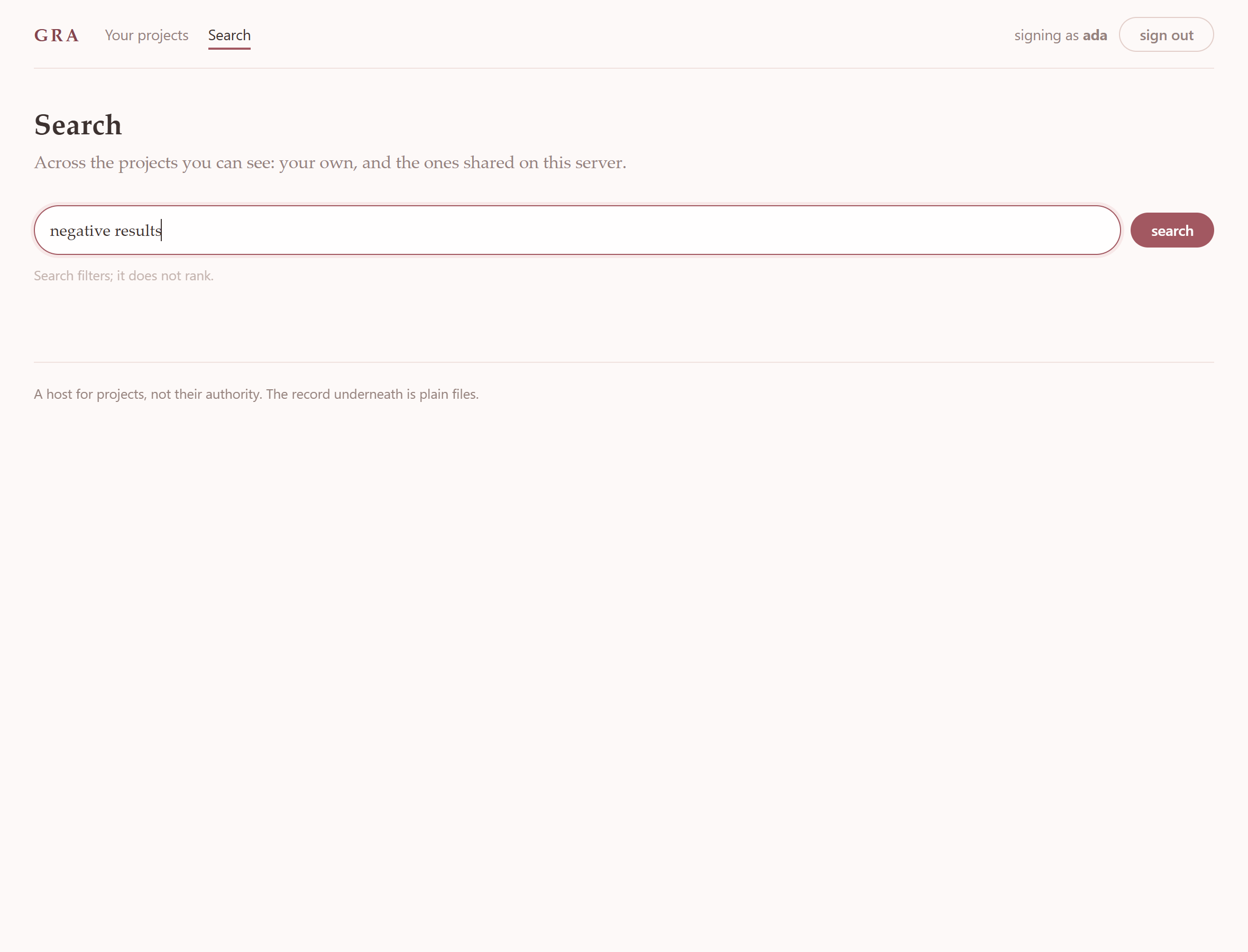
Reading what people have shared, and searching it, needs no account: an account is access to one host, not permission to look, and a front door that showed nothing until you signed in would have already decided it was the authority. The hosted interface is being built as a host for projects which is not their authority — it stores no private key, computes no quantity over anyone, and can be deleted without costing anybody a record.
$ grrp show
trust   (trust)
  question   Is trust a property obtaining between individuals?

  live positions
    960f13b89624  Narrow the account to institutional settings.
    9168b1900d17  Keep the general scope and weaken the claim.
    these diverged. Neither is the canonical one.

  unanswered
    a670a1a0d460  question    Is trust a property obtaining between individuals?
    68985dd9b7cb  challenge   The revision cannot now distinguish trust from complian…

  unattested throughout - useful to you, evidence to nobody
Derived from the log, never stored. The last line is the honest one: a record you registered yourself is useful to you and is evidence to nobody.
Withholding, and what a ground still owes
An arrangement that records how understanding changes must be able to withhold. The question is never whether but on what ground — and what follows from the ground. Nothing here confers a right to exclude: withholding is justified by a reason, never by a title, and the reason does work, because it determines what is withheld and what must still be disclosed.
| Ground | What it restricts | Residue — must still be disclosed |
|---|---|---|
| rivalry | access to a resource admitting limited simultaneous use | the trajectory in full |
| hazard | the propagable content of a method | existence, questions, decisions, interpretations, non-conveying results |
| exploratory vulnerability | the timing of exposure | everything, at the scheduled time |
| appropriability | content whose disclosure destroys excludability | existence, questions, decisions, negative results |
The residue rule is the operative rule of the whole design. Without it every ground collapses into the same thing — silence with a justification attached. With it, a restriction becomes a dated, attributable assertion, and a reader has one checkable question: was what the ground leaves disclosable in fact disclosed? A declaration accompanied by its residue costs the declaring party something; a declaration withholding it costs nothing, and the second is the signature of misapplication.
- Disclosure is monotone. It may widen and must not narrow. There is no
unpublish— a party who has read a record retains what they read, and an arrangement offering the appearance of withdrawal misdescribes to its own participants a state of affairs obtaining outside it. A scheduled release may be shortened, never extended. - Restriction is per record, never per repository or per project. One line of work carries states disclosed to everyone, to a group, and to nobody, with the differences declared and grounded.
- Content is separable from the attested skeleton, so redaction removes content while leaving the graph and the signature chain intact — and the record of the redaction is never removed.
The design cannot separate the valuable from the dangerous within a trajectory, because they are the same material — so it separates the parties to whom it is disclosed rather than filtering the content.
How it is adopted, if it is
The design assumes it will be used first by one researcher, alone, with no collaborators. If the tool is not worth using by a single person on the first day, nothing that follows happens.
| Tier | Adds | What its adopter gets |
|---|---|---|
| Personal | transitions with parent links · append-only log with derived views · content separable from skeleton | a searchable record of what was ruled out and why, a standing list of objections not yet answered, and a citable release with its chain |
| Group | attestation by a distinct party · CRediT roles · absorption links · disclosure classes with grounds | evidence — credibility begins where a second party registers; visible attribution; onboarding a new member from the record |
| Open | propagation with declared profile · distributed custody · archival deposit · operator-independent identifier resolution | exchange with parties elsewhere, and continuation of the record beyond any operator |
The personal tier delivers utility and no evidential weight, and the two must not be confused. Every transition in a self-registered trajectory is marked unattested, and stays marked on export. Each tier returns something at its own scale, so no party is ever asked to act on a benefit that requires others; and the minimum viable adopting unit is small — two parties who register each other's transitions. A design whose minimum unit was a discipline would need an agreement nobody can broker. This one needs a decision two people can take on a Tuesday.
A trajectory also holds states whose disposition is unresolved, and that set, published at each disclosure class, is a register of open problems. Any party holding no prior position at all may reference one — decided on the act itself. The usual qualifications fail here: demonstrated contribution requires access in order to be satisfied and grants access in return for satisfaction, and trust extended by existing participants has the same shape with an extra step. Both are closed against every party who holds no prior position, which reproduces at the scale of a working group exactly the exclusion the project diagnoses at large scale.
What it does not claim
The papers spend a substantial part of their length forbidding specific claims. They are repeated here because they are the ones most likely to creep back into a description of the work.
- It does not democratise recognition. Standing is a positional good: the aggregate available in a field is fixed by construction, so making more contributions visible redistributes recognition and does not create it. What may be claimed is that it changes what competition rewards — and that attribution mechanisms will therefore be resisted by parties who benefit from the present invisibility of others' contributions.
- It does not produce serendipitous encounters. There is no evidence that infrastructure increases productive unplanned encounter, and the strongest qualitative study of an arrangement designed to produce it reports occupants developing strategies to avoid it. What may be claimed is a lowered cost of preparation.
- It does not measure capacity. Two trajectories may coincide entirely in their recorded appearance while differing entirely in the generativity of the relations that produced them. The record holds what occurred, not what the relation was capable of.
- It does not make another party's work continuable from where they stopped. A record carries only the articulable fraction of what its participants held. What transfers is the redirection of attention — that an approach was attempted, on what assumption, and what obstruction was met.
- It computes no scores. No quantity over participants or trajectories and no total order over either: not transition counts, not attestation depth, not contribution shares, not “trajectory health”. This costs the arrangement the ability to report that a project is going well, or to rank contributors for a committee, and the cost is real and accepted.
- It requires no AI. Every conformant operation is performable with a text editor and a version-control system. A model may propose a transition and may not author or register one, and a model-originated proposal is marked as such.
- It has no merge. Two revisions of a concept do not compose, no conflict region localises, and no test decides the result. Integration appears only as a synthesis or an absorption. In inquiry a fork is frequently the correct outcome, and plurality is the normal shape of a healthy record.
What is unsolved, and how this would be shown to have failed
A difficulty counts as addressed only where there is a mechanism, an identified party who bears its cost, and a stated condition under which the mechanism fails. Four fail that test — and they are stated as open rather than as oversights.
- Assessment capacity. Every mechanism lowers the cost of contributing and lowers the cost of assessing by nothing, so congestion follows from the design working. The usual remedy — ranking — is excluded. This is the difficulty most likely to determine whether a conforming arrangement survives at scale.
- Maintainer labour. Unfunded, concentrating on few parties, growing with adoption. The open-source record is a warning here, not an encouragement.
- The regressive incidence of overhead. Recording falls hardest on those with the least time and the least standing — the population the diagnosis concerns. The byproduct principle addresses the magnitude and the timing of that cost, and not its distribution.
- Recognition of attributed contribution. No property of a protocol makes a community count what it records.
Four failure signals, stated in advance so they can be looked for: personal-tier adoption without progression to the group tier, over a substantial population and period — the arrangement would have become a note-taking convention; records in which the decision act is rare while transformations are common; group-tier declarations alongside pairs who register only each other, attestation operating as a formality; and a widely used external score computed over conformant records.
Beyond that, the whole account is withdrawn on any of: a deployed system or published specification already taking the transition between identified states as its unit with registration by a distinct party; evidence that the earlier rationale-capture systems failed for reasons other than capture cost; or evidence that the artefact's separating condition has not weakened.
The repository
| Paper | What it does |
|---|---|
| I · Designing the infrastructure | The problem, the prior art conceded in full, and sixteen requirements derived from it. |
| II · Incentives and adoption | Whether any of this happens. Where the commons dilemma sits, the positional bound, the absorption test, and ten predictions with their refutations. |
| III · Grounds of restriction | Disclosure governance: four irreducible grounds, each with an object, a residue, and a named failure. |
| IV · Specifying the GRRP | The normative specification, v0.1 — record model, act vocabulary, attestation, absorption, disclosure, redaction, identity, propagation, conformance tiers and tests. |
The reference implementation grrp records trajectories as typed transitions in an ordinary git repository, in plain text, with no server, no account and no network. Its milestones run from a canonical-hashing skeleton through the personal tier, the full act vocabulary with redaction, the group tier with signatures and performer ≠ registrar, CRediT attribution and absorption, disclosure classes, and the open tier with bundle-and-continue.
grrp new "Is trust a property obtaining between individuals?"
grrp claim     -m "Trust obtains between individuals."
grrp challenge -m "This omits institutional power."      # defaults to the live position
grrp transform -m "Trust is shaped by asymmetry of power." --answering <challenge>
grrp decide --abandon      # omit -m and your editor opens, asking for the reason
grrp connect --to doi:10.1234/x -m "Same obstruction, other field."

grrp show     # where this stands: question, live positions, what is still open
grrp open     # what you still owe an answer to — and the entry path for strangers
grrp release && grrp export <release> -o paper.md
The protocol now exists twice — in Python and in TypeScript, agreeing byte for byte on shared test vectors. A protocol nobody has implemented twice is a protocol whose specification has not been tested, and that suite found a real defect on its first run, where the two languages stripped different sets of trailing whitespace and produced two different identifiers for the same document.
Conformance is self-declared and checkable from the record. There is no certification body and none is required: a doubting party obtains the record under the continuation requirement and verifies the signatures, the identifier construction, and the presence of the required fields.
Standing, and a declared conflict
Stage 0 — and what that means here
The specification is v0.1, published with an amendment procedure rather than as finished, because a specification published as finished would contradict the account it specifies. The protocol has no deployment history and no evidence of use: every requirement in it is a proposal about what such use would need, and the requirements are expected to be wrong in ways argument cannot anticipate. The reference tool implements the protocol through the open tier and its acceptance tests pass, but it has not yet been used on real work.
Amendment is itself conducted through a conforming record: a proposal is a state, objections are challenges, revisions are transformations, and adoption is a release at the widest class — enumerating the objections that stood unresolved at the moment of adoption.
Declaration of interest
GRA is developed by the Serendip Commons Society, which would host an implementation of the protocol and is a candidate custodian of the specification. Two rules follow and are held without exception. The Society's activity is evidence for no claim in the papers. And every requirement imposed on a custodian applies to the Society itself — including that the specification be forkable, that stewardship of the specification be separated from operation of any implementation, and that any conflict be recorded together with the arrangements limiting it.
The papers state that an arrangement in which the proposing party maintained the charter, operated the implementation, and held the restricting authority would be an instance of the concentration the project diagnoses. Declaring that conflict is a condition of the account's coherence, not a courtesy.
Licence, and how to disagree
The software is AGPL-3.0-or-later, and the choice is not incidental. The specification must be licensed so that any party may fork it, or custodianship is a position rather than a service; and a record must be licensed so that continuation elsewhere is permitted. What the AGPL adds is the network clause, which bears on the central risk: a host running a modified GRA as a service would have to offer its modifications, so a closed fork cannot become the place everyone's records live — the failure this whole design is arranged against, and the one a permissive licence would leave open.
Three things it deliberately does not reach: the protocol — an independent implementation does not inherit the licence merely by implementing the specification; research records and contributed content, which remain under whatever their authors specify; and the four papers, which carry CC BY-NC 4.0 in their own notices and remain under it.
The most useful contributions are the ones that would show the account wrong: a system or specification that already occupies the gap; a reasonable restriction that fits none of the four grounds, which would show the set incomplete; or a demonstration that an act the protocol requires has no purpose for the party performing it.
Classified under Domain II (Epistemic) of Schedule A, with Domain VII (Normative) and Domain V (Co-creative) as secondaries. A formal project-approval instrument (SCS/PA/…) has not yet been issued.