The Science Infrastructures
The sciences as one connected body of knowledge, to be learned, used and extended.
An open, integrative infrastructure for learning, using and researching all domains of science, in theory and in practice. Foundation libraries carry mathematics, computation, physics and inference. Each science is a domain: a library of its own objects and models, pure and tested, that runs on its own with only the domains beneath it. Applications and studies, organised by purpose, compose the domains they need. Each part can grow, change or be replaced without disturbing the others.
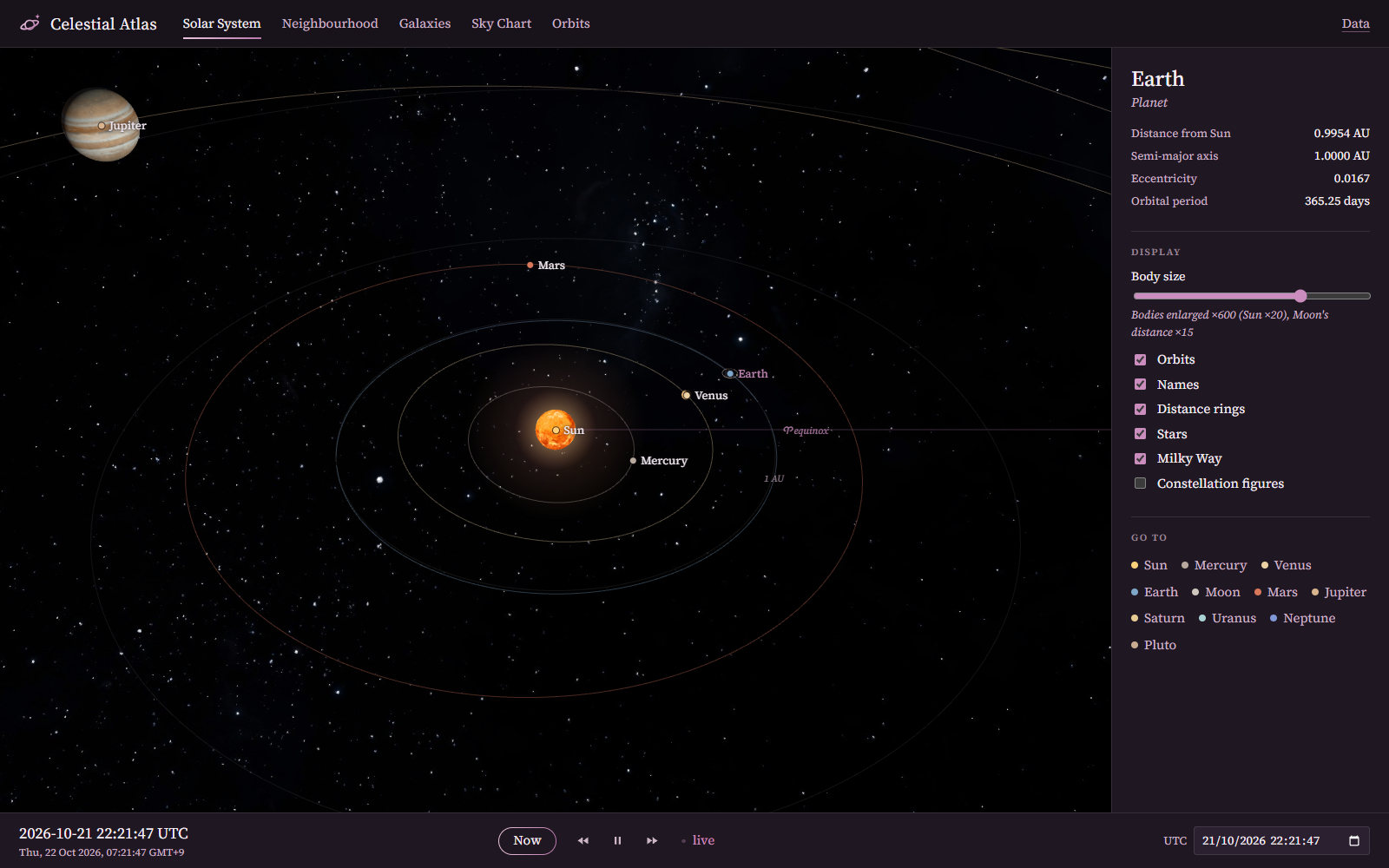
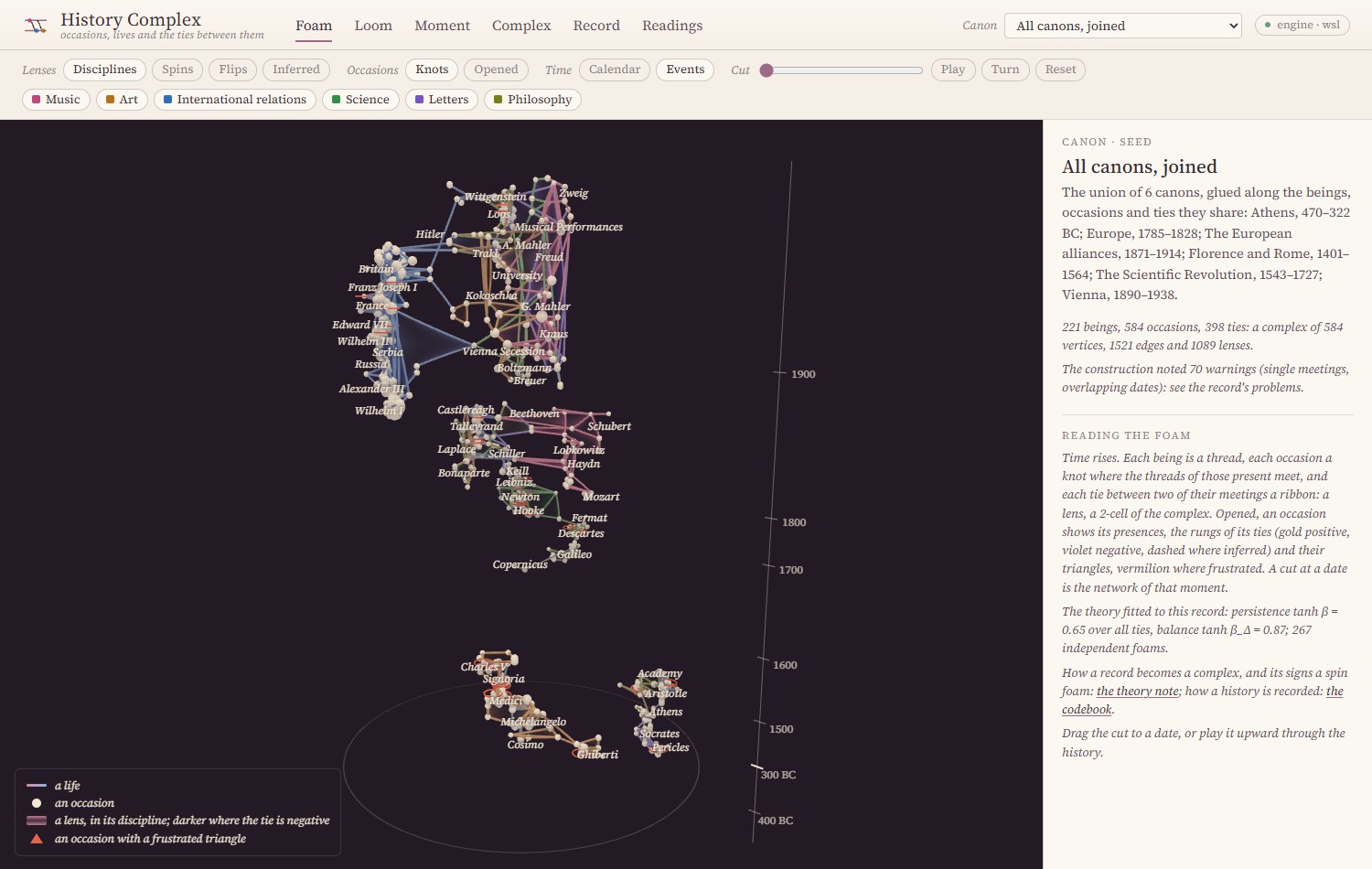
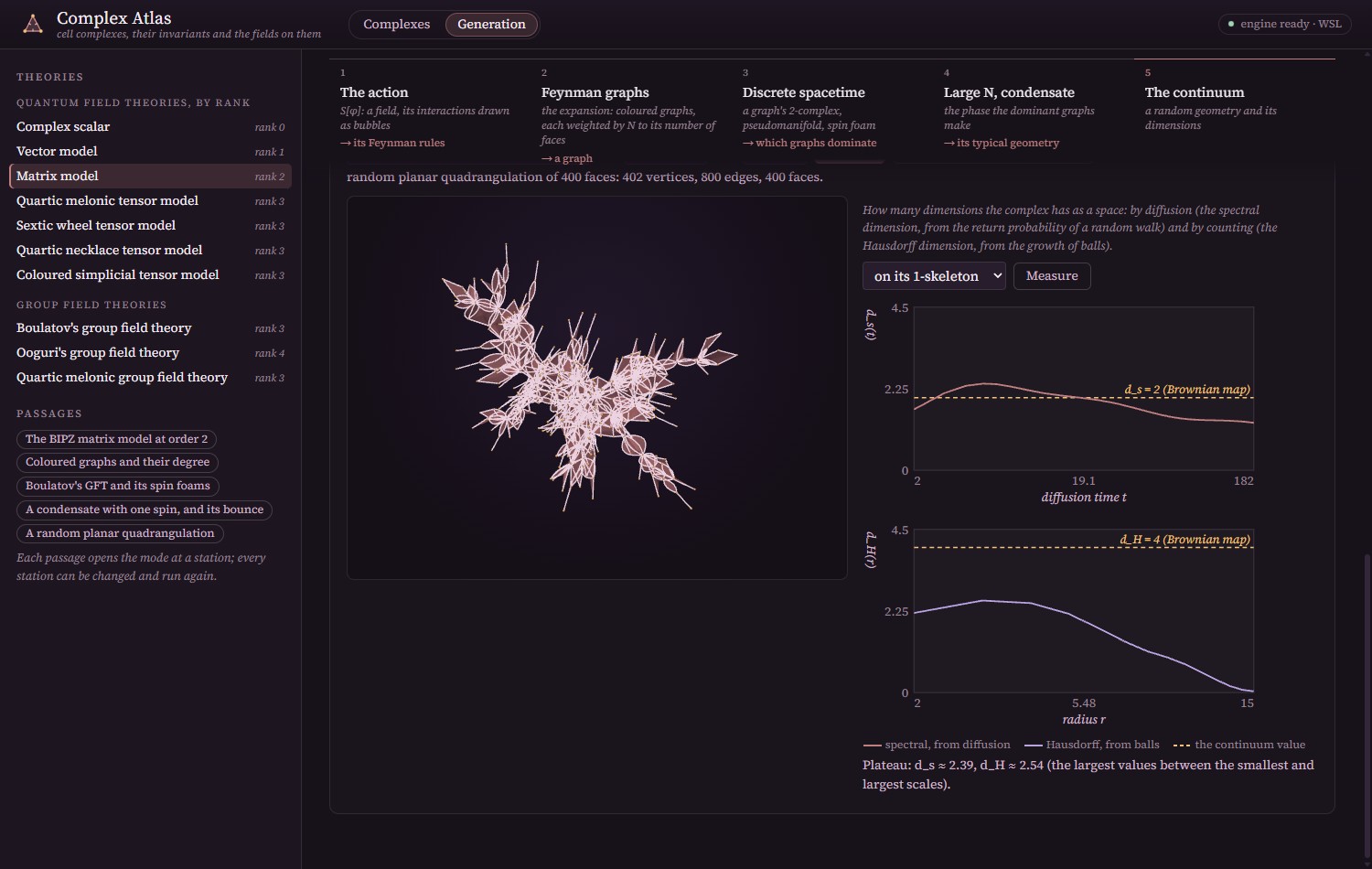
The sky, a history, and a random geometry: three of the infrastructure's ten applications.
Structures shared by the sciences
The sciences are taught and practised apart, yet the same structures recur across them. Symmetry: groups act on molecules and crystals, on the sphere of the sky, on quantum states and on sequences, and their representations give spectra and harmonics. Conservation and change: the same equations transport heat in the ocean, chemicals in a cell and populations across a landscape. Networks: food webs, neural circuits, reaction networks and economies are graphs with dynamics on them. Sequences and grammars: genomes, languages and programs are strings with structure. Inference: every field estimates hidden states from noisy observations.
An infrastructure that holds the sciences together makes these connections explicit. It shares one implementation of each method, tests it once, and reuses it everywhere. The sciences are taken in the broad sense of the German Wissenschaft, the social sciences and the humanities among them: a language is a grammar, a chronology is a reference frame, a market is a network.
Three tiers
| Works | Applications and studies, organised by purpose, each composing the domains it needs. |
|---|---|
| Shared edges | Data (a registry, acquisition, products, requests on demand), visualization, observation and sensors, and an API through which other programs reach the infrastructure. |
| Domains | One library per science, pure and tested: fields, and bridges between them. |
| Foundations | Mathematics, computation, physics and inference, written once and used by every domain. |
The domains are ordered by what each may depend on. The order is acyclic, and each domain passes its checks alone with what lies beneath it:
height 4   climate
height 3   tides · navigation · air–sea · planetary science
height 2   astronomy · geophysics · geography · oceanography · meteorology
height 1   geodesy · evolution
height 0   metrology · neuroscience · history · genomics · economics · robotics
           ──────────── foundations: physis ─► calx, morphe · tyche
The foundations
calx
Computation: a retargetable stack and numerical methods, from linear algebra, integrators and special functions to task graphs, vector lanes and real-time scheduling.
morphe
Mathematical structures and their equivalences: exact arithmetic, groups and their characters, complexes and their homology, words, grammars and their parsers.
physis
Geometry and physical law: units, mechanics from a discrete action, rotations and frames, fields as sections, lattice gauge theory, spin foams and group field theories.
tyche
Chance and inference: distributions, the description of samples, regression, time series and spatial statistics.
Three activities
Every artefact says which it serves: learning (derivations, worked examples, expositions), use (tools whose numbers can be relied on) or research (open questions and new results).
Verifiable
Numbers are held to authoritative references, among them SOFA and ERFA, JPL Horizons, the IERS Conventions and GeographicLib, each with its source and date; theory is checked by computation where it can be.
What it draws
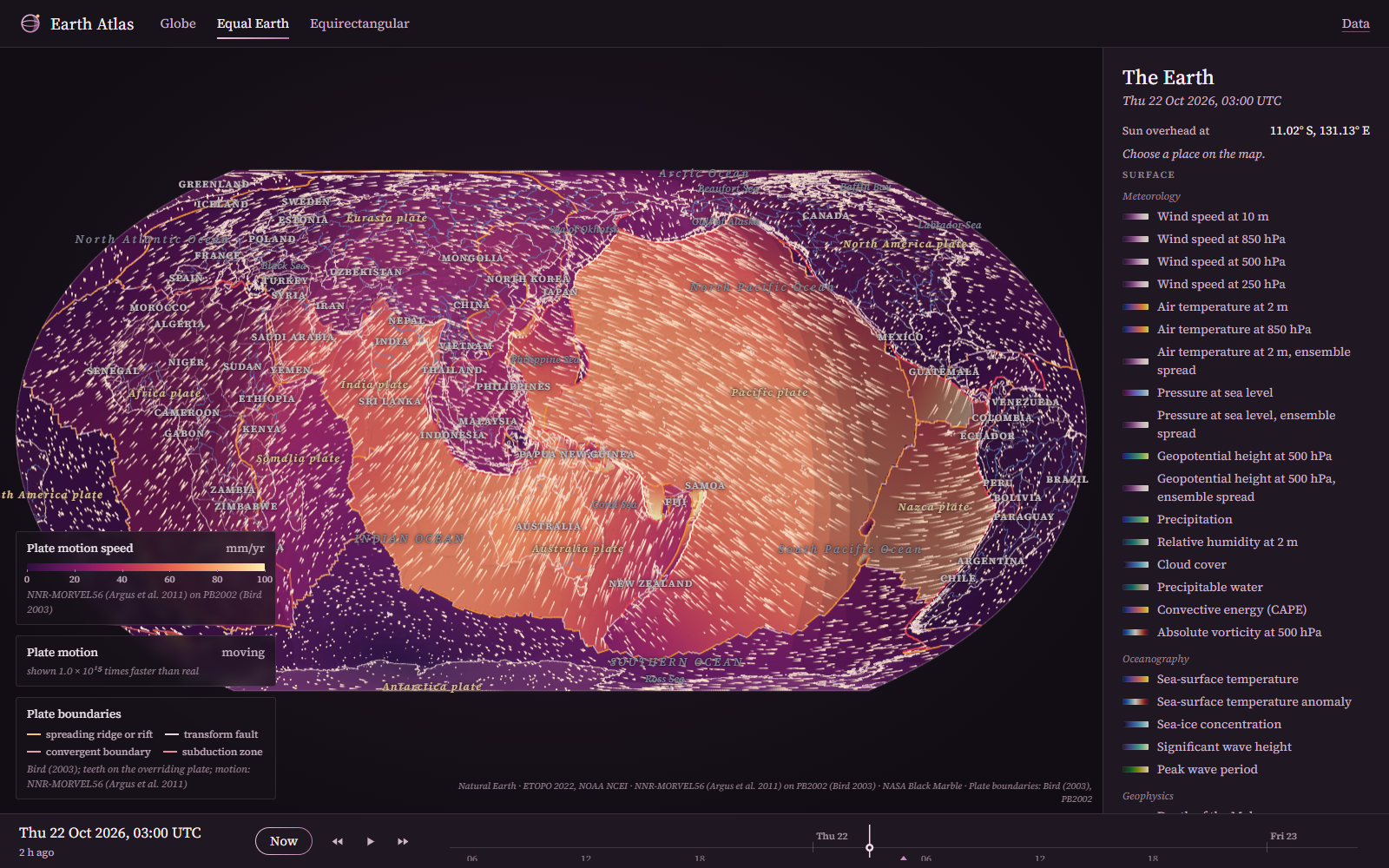
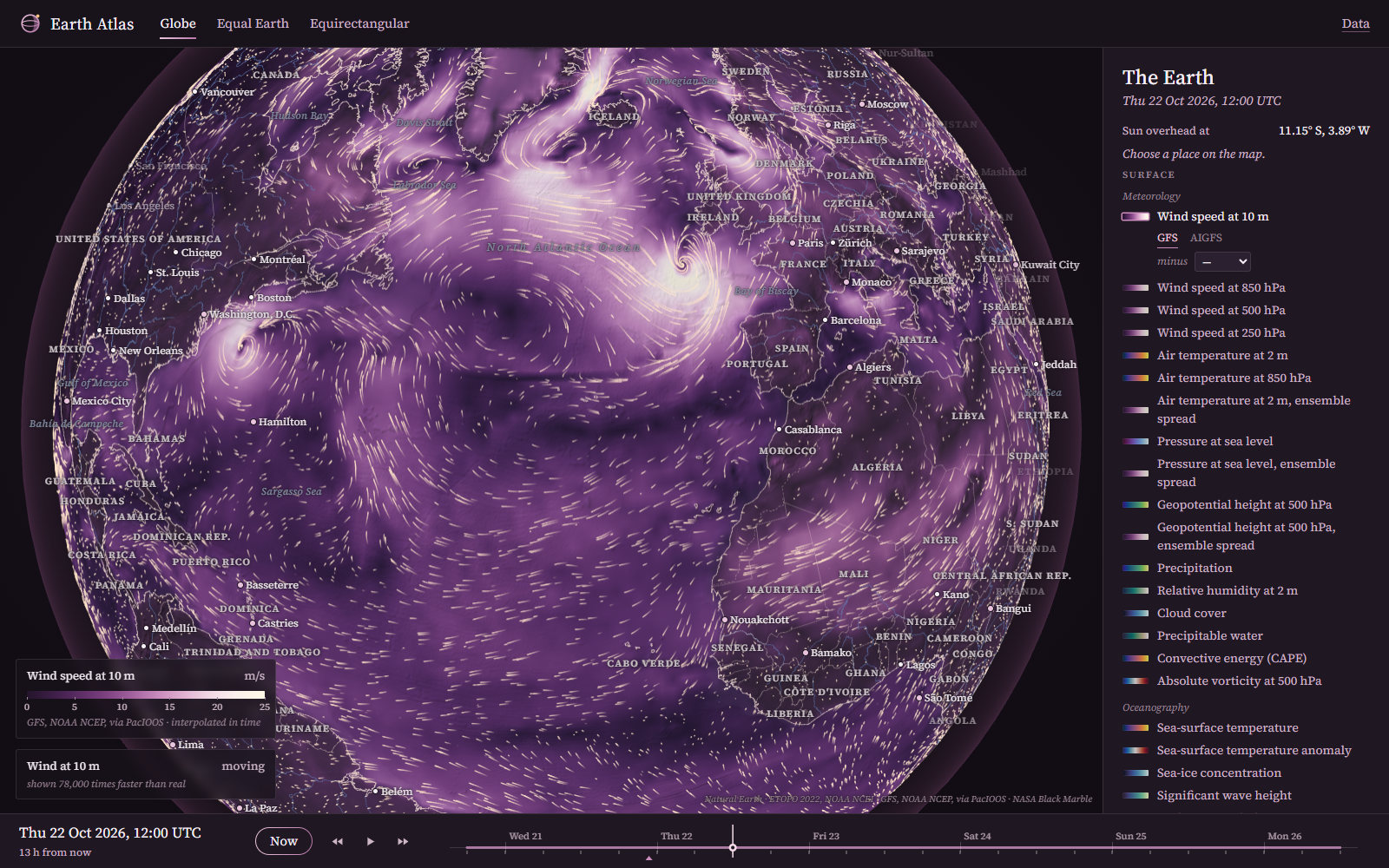
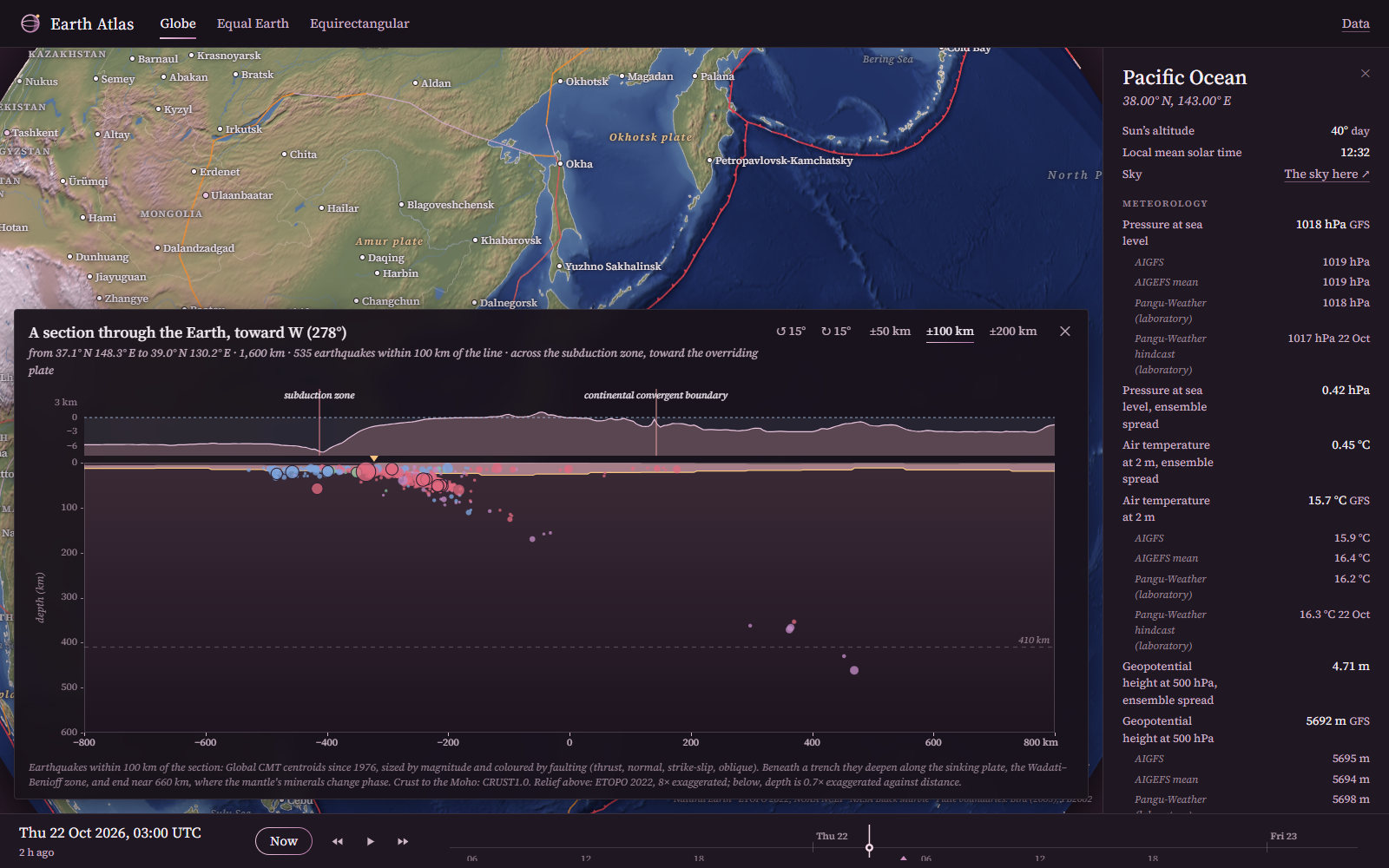
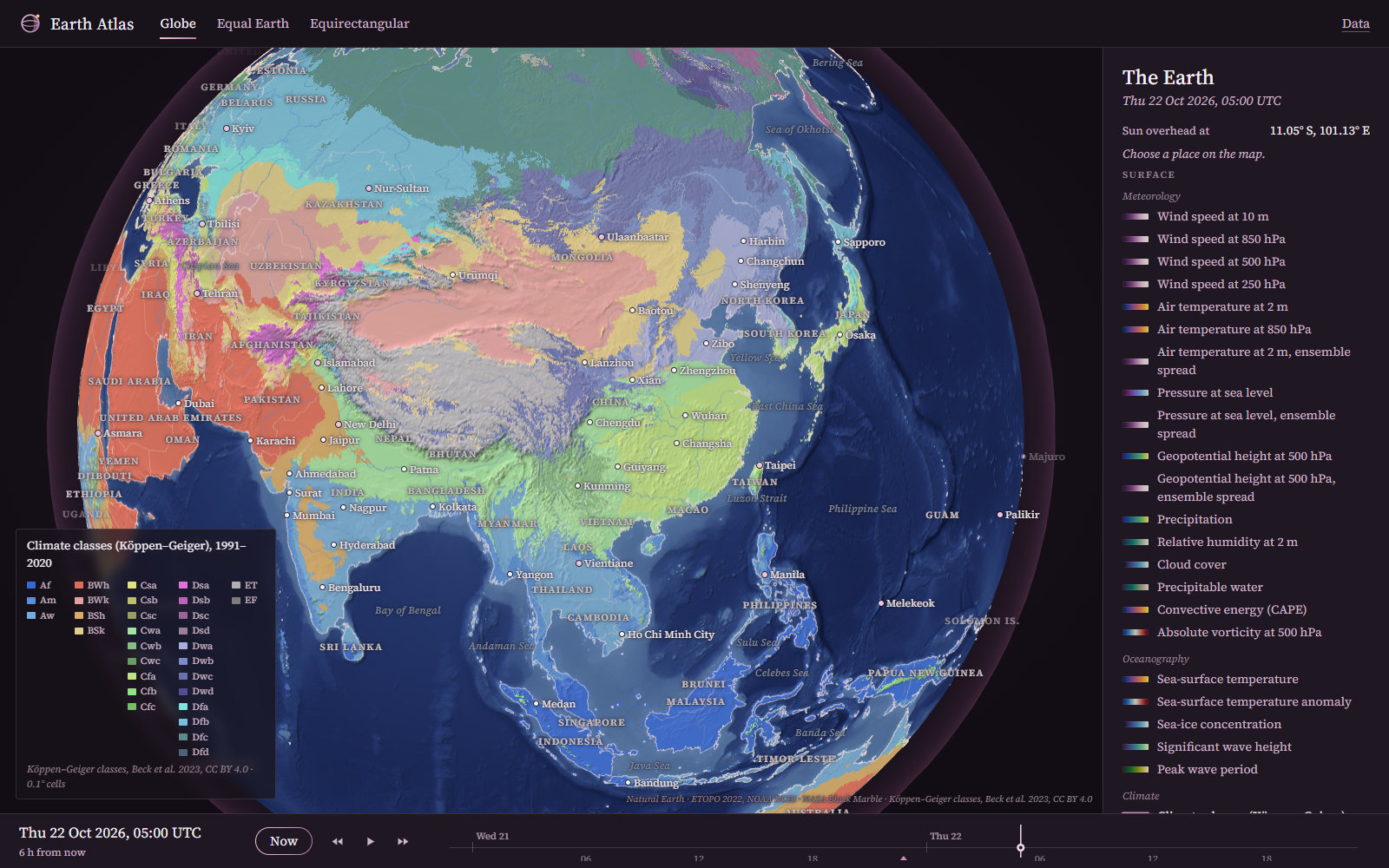
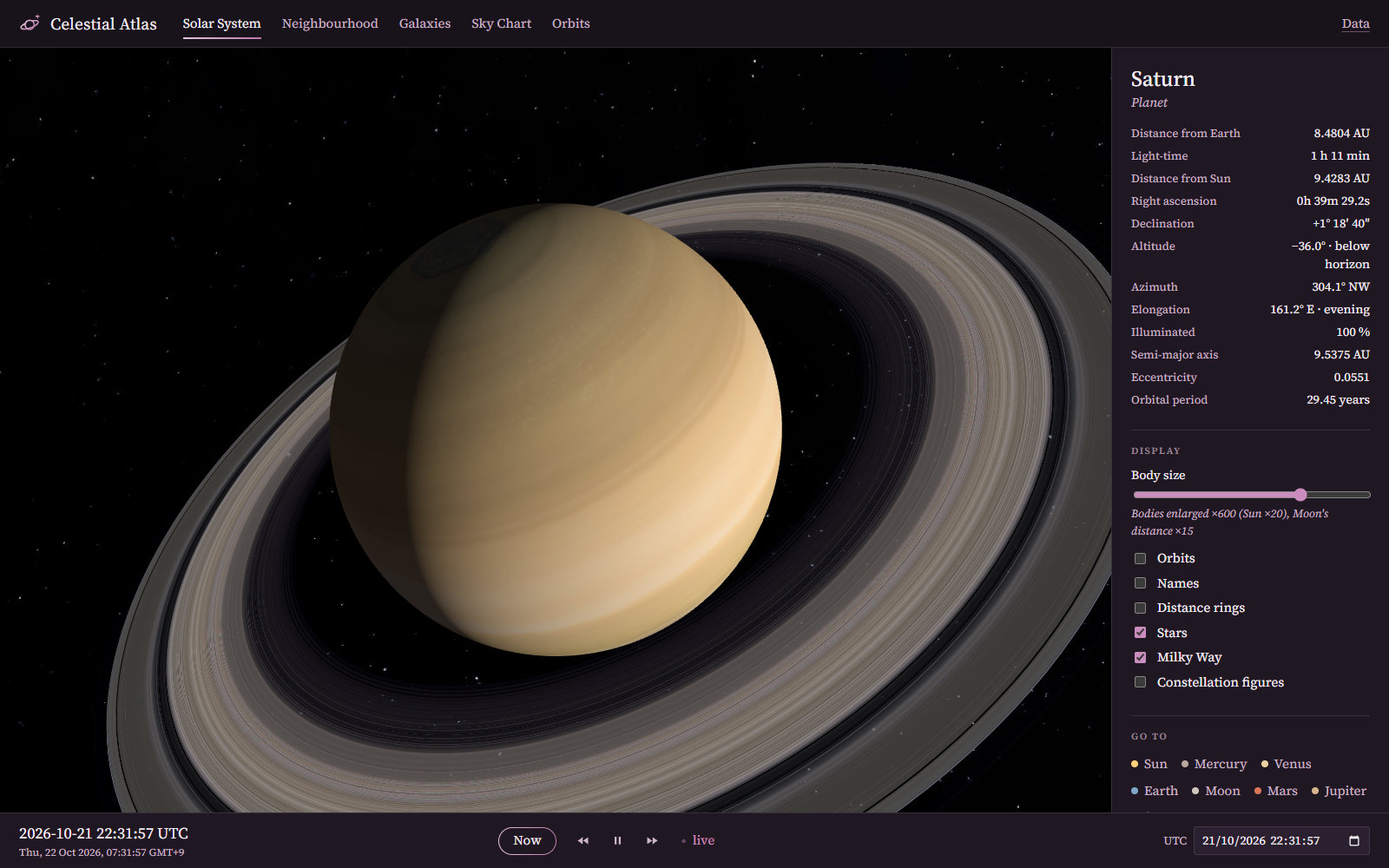
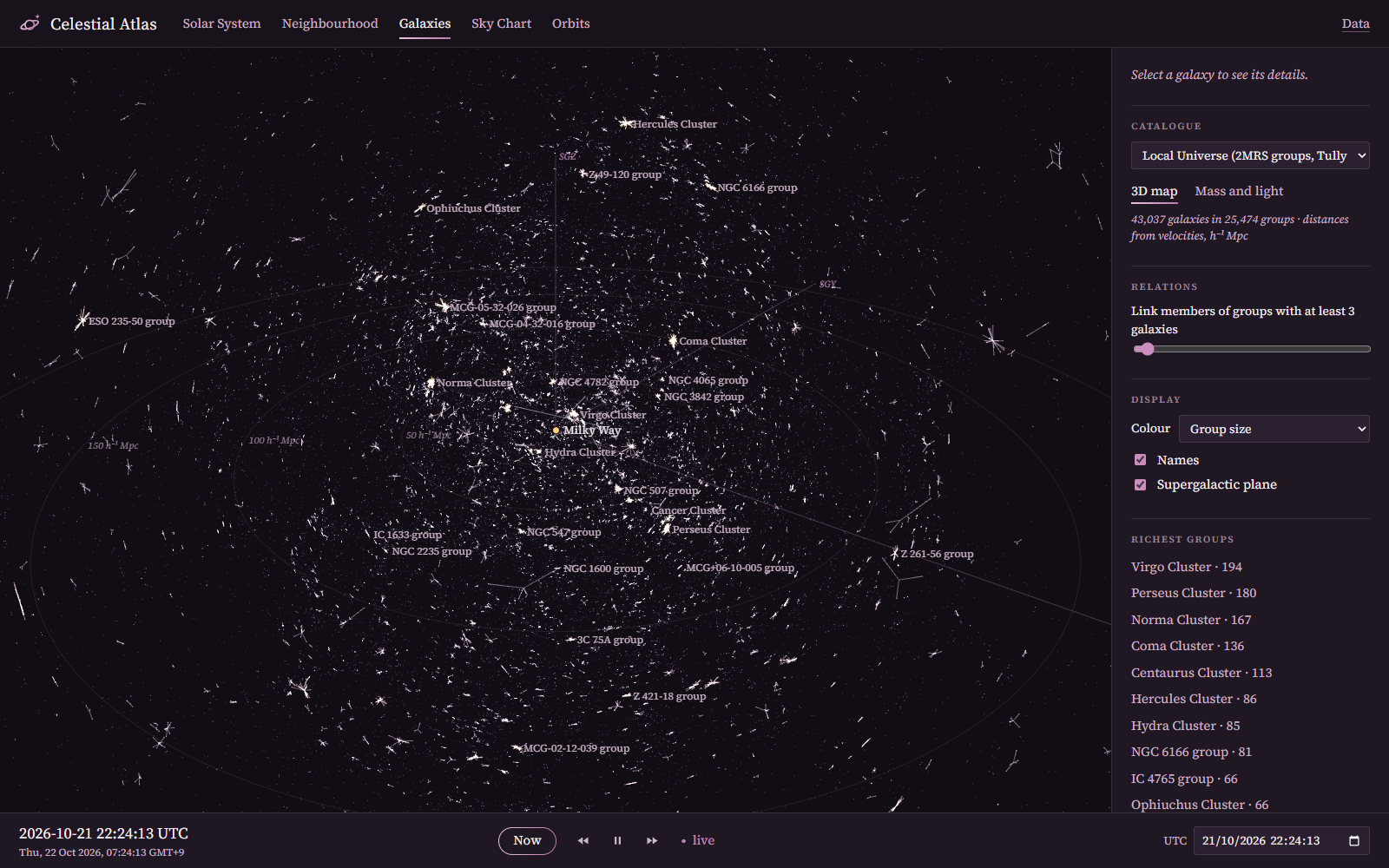
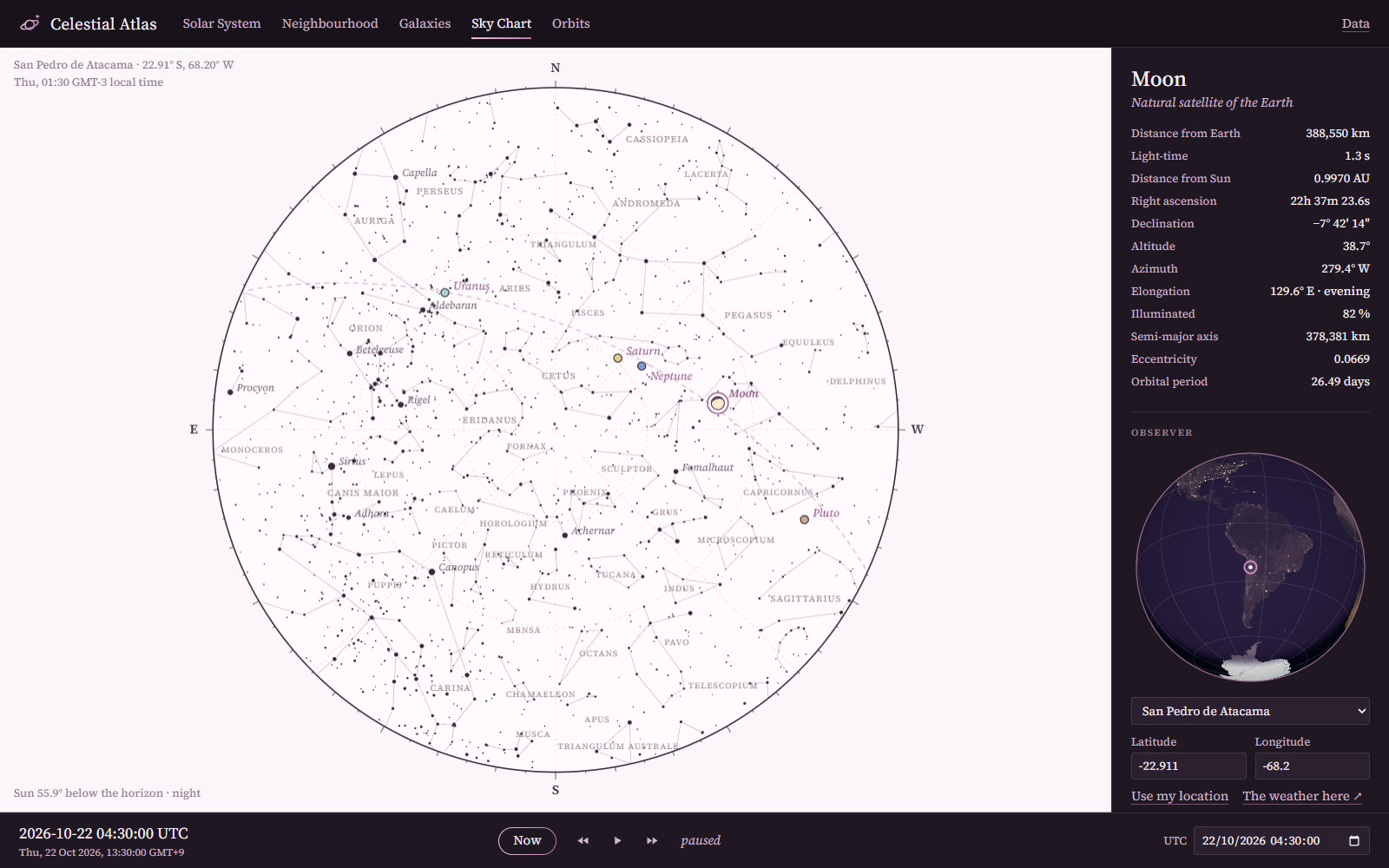
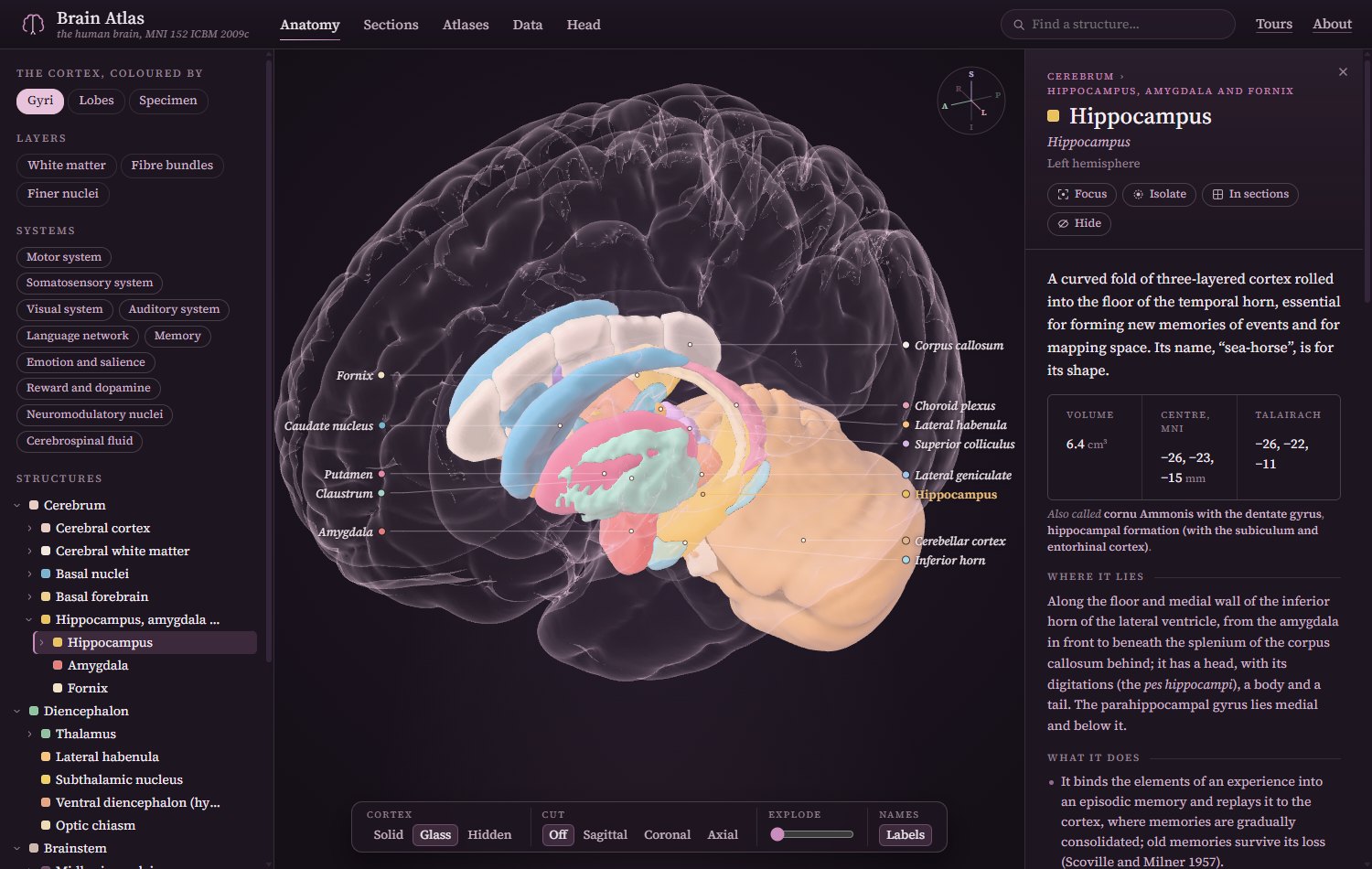
Ten applications compose the domains. These pictures are from the repository's gallery, where each caption says what is shown, where its data come from and how it was made. Select a picture to see it at full size.
The Earth Atlas
The atmosphere, the ocean, the land, its people and the solid Earth on one globe or on equal-area maps: forecasts from several models and two of its own, the ocean beneath any place, the plates and their motion, earthquakes, the crust, and climate from 1901 to 2099.
The Celestial Atlas
The Sun, the Moon, the planets, the stars and the galaxies at any instant from 1849 to 2150, and the sky from any place on the Earth.
The Brain Atlas
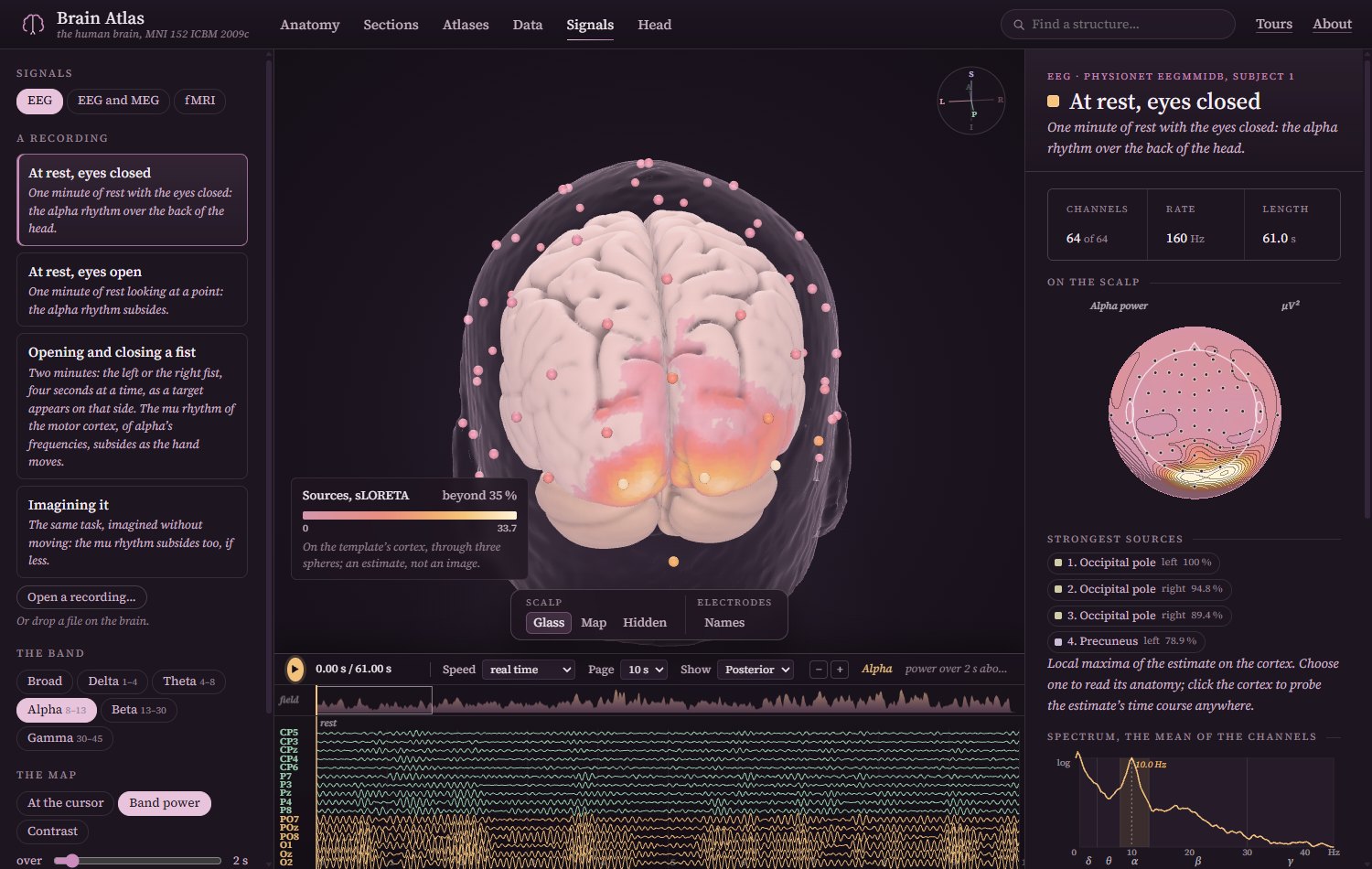
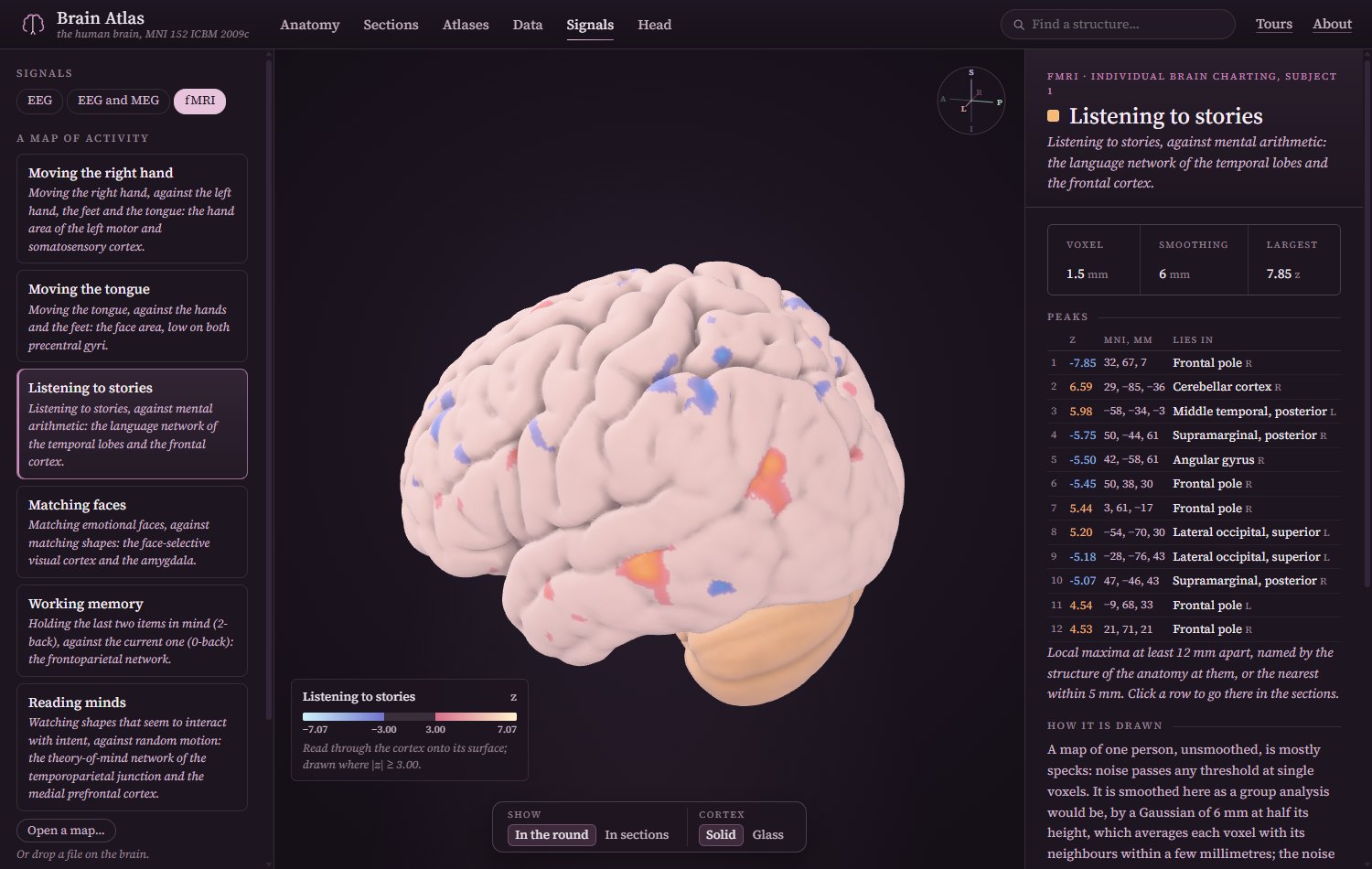
The human brain in the round, every part with its anatomy; sections, atlases, the head and its electrodes, the mouse brain, and EEG, MEG and fMRI carried onto the cortex.
The Spiking Simulator
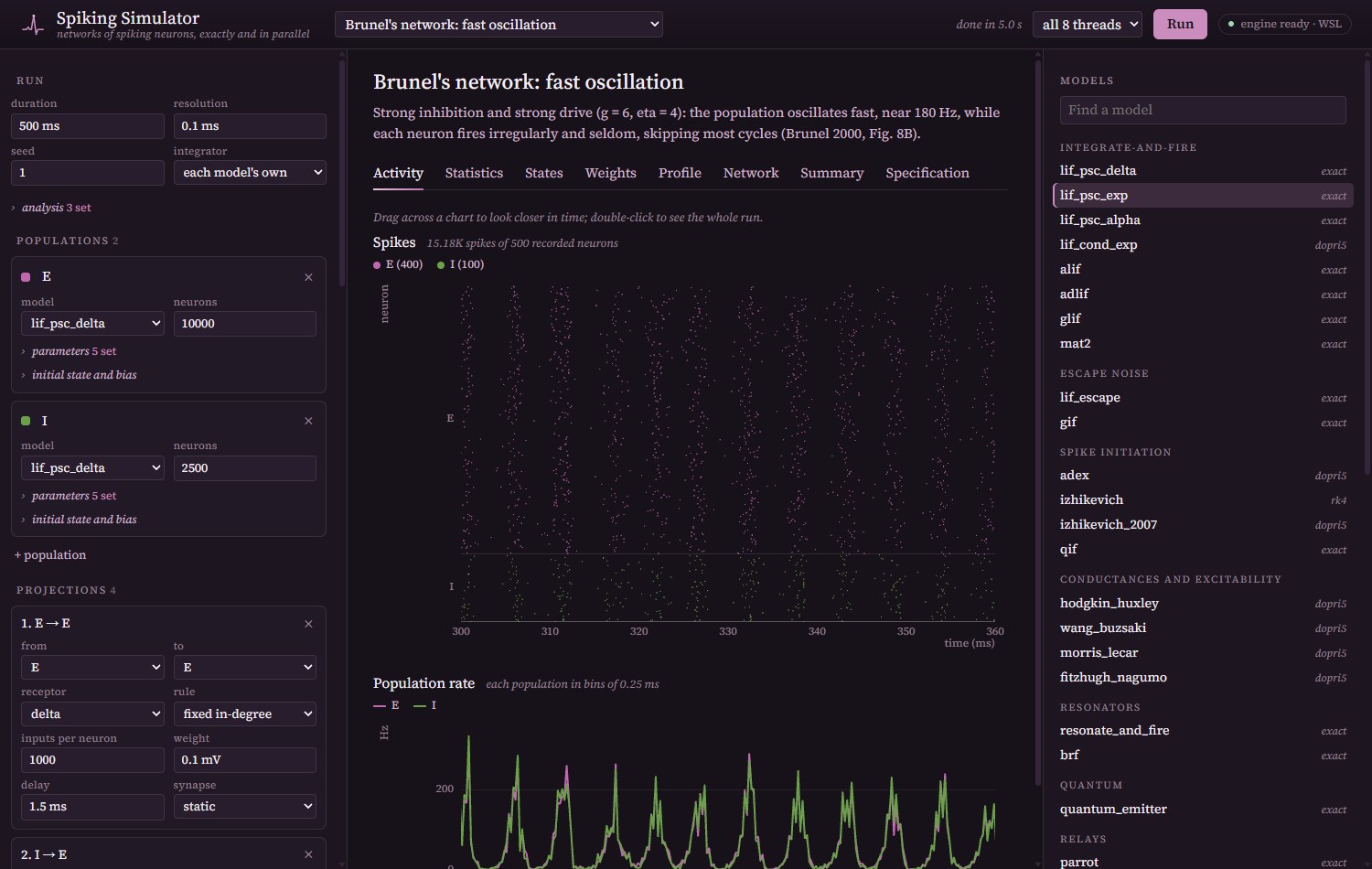
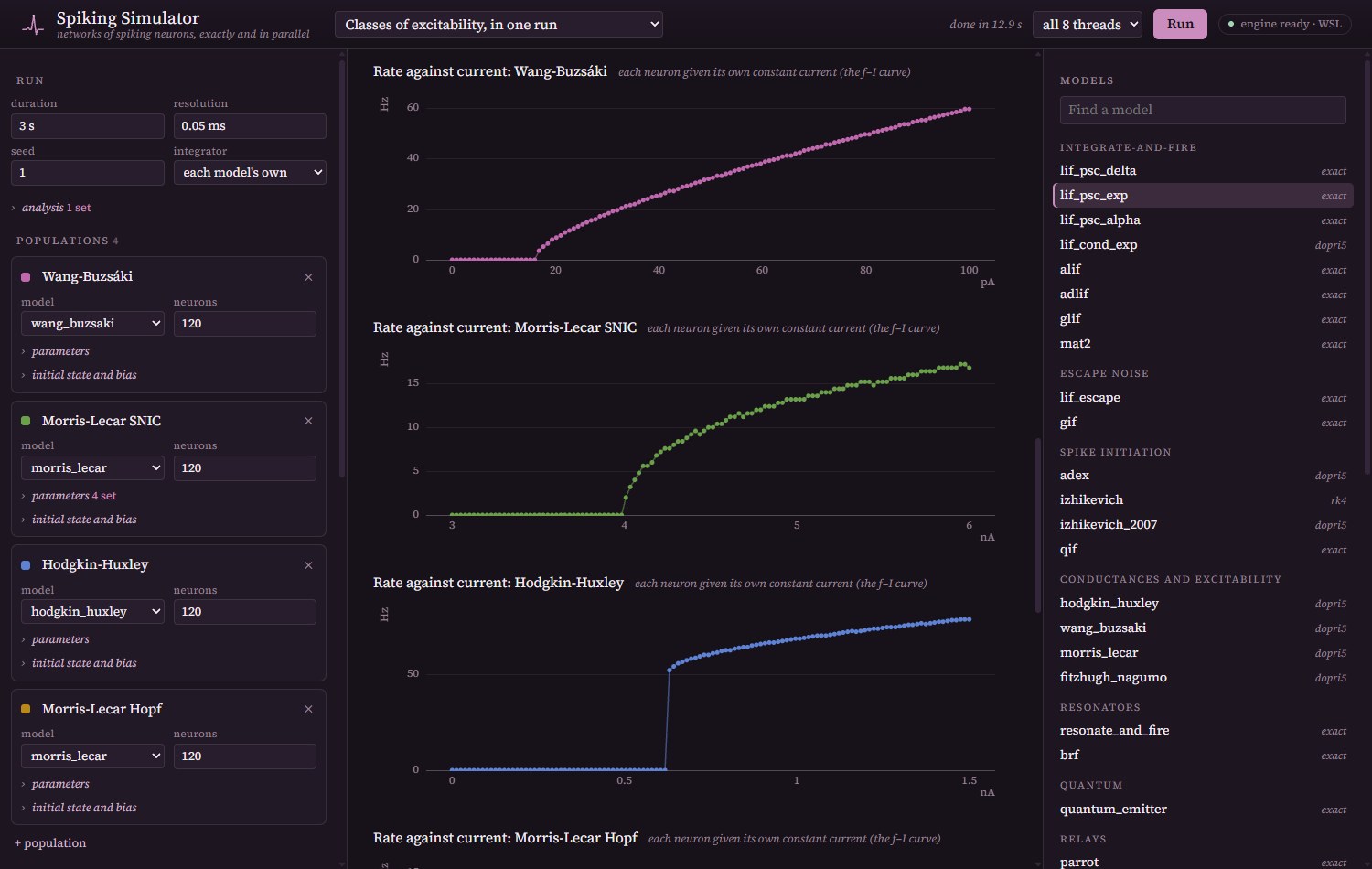
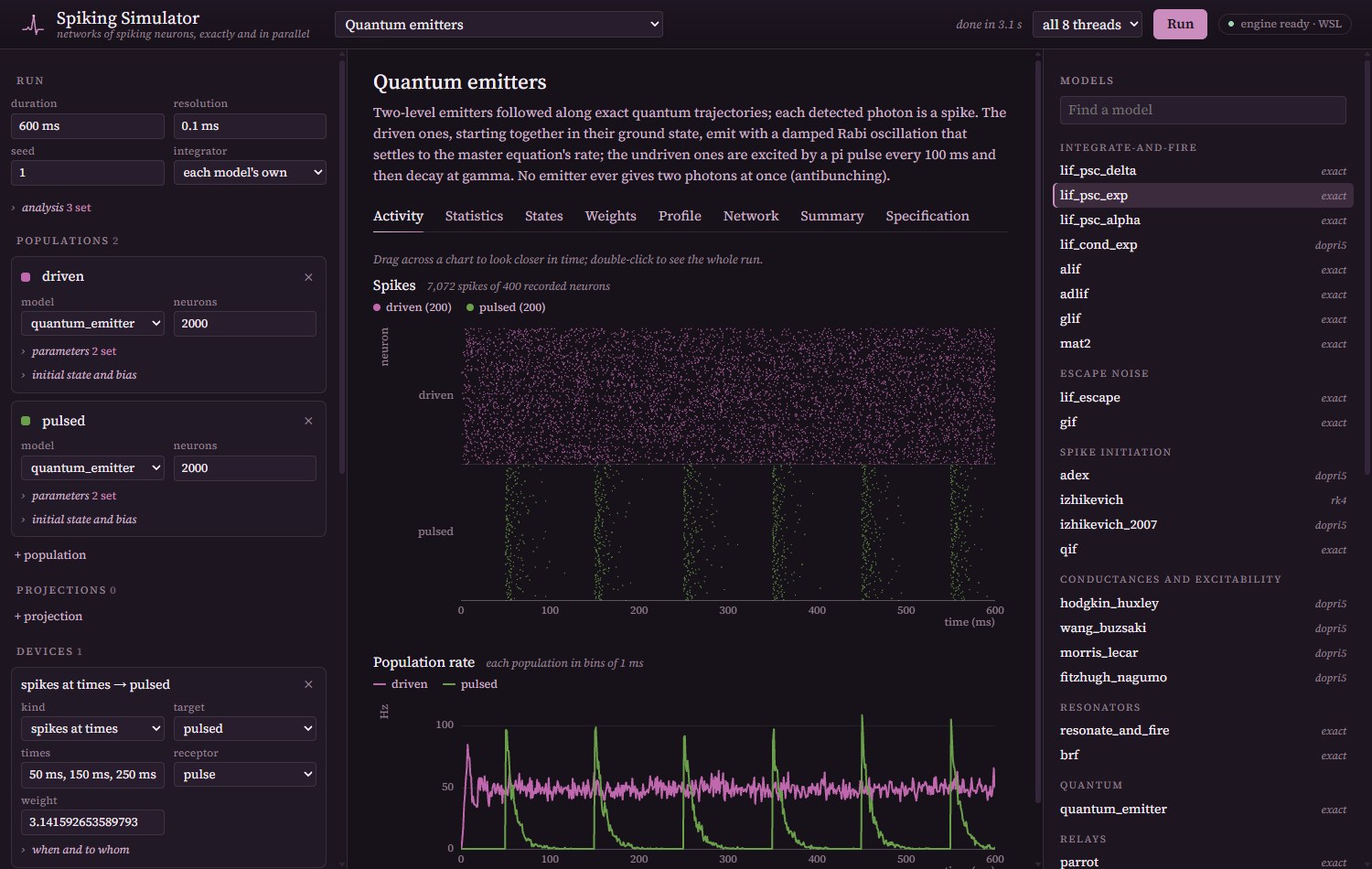
Networks of spiking neurons from twenty-two models, classical and quantum, run by the neuroscience domain's C++ engine with the same spikes on any number of threads.
The Complex Atlas
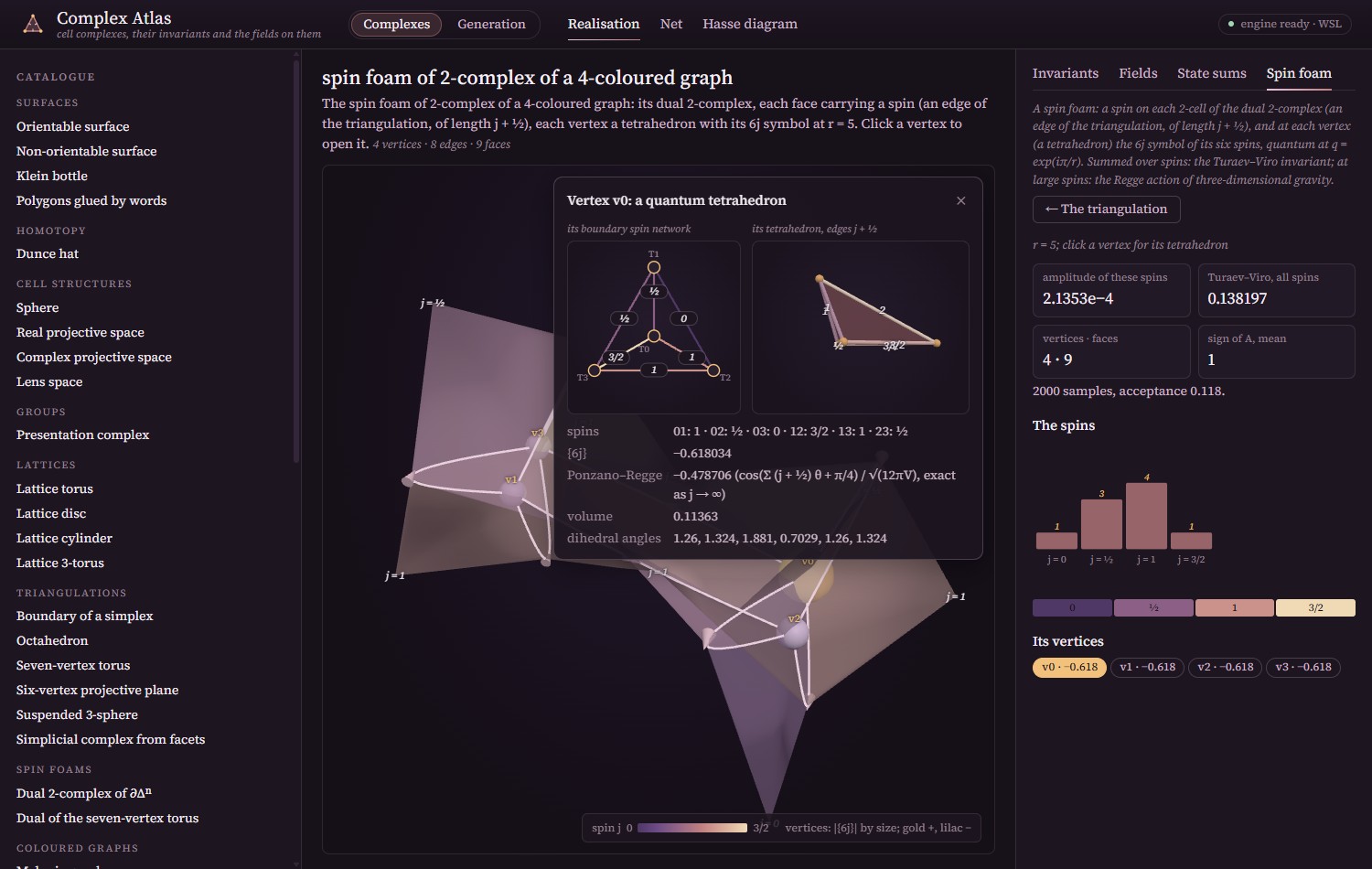
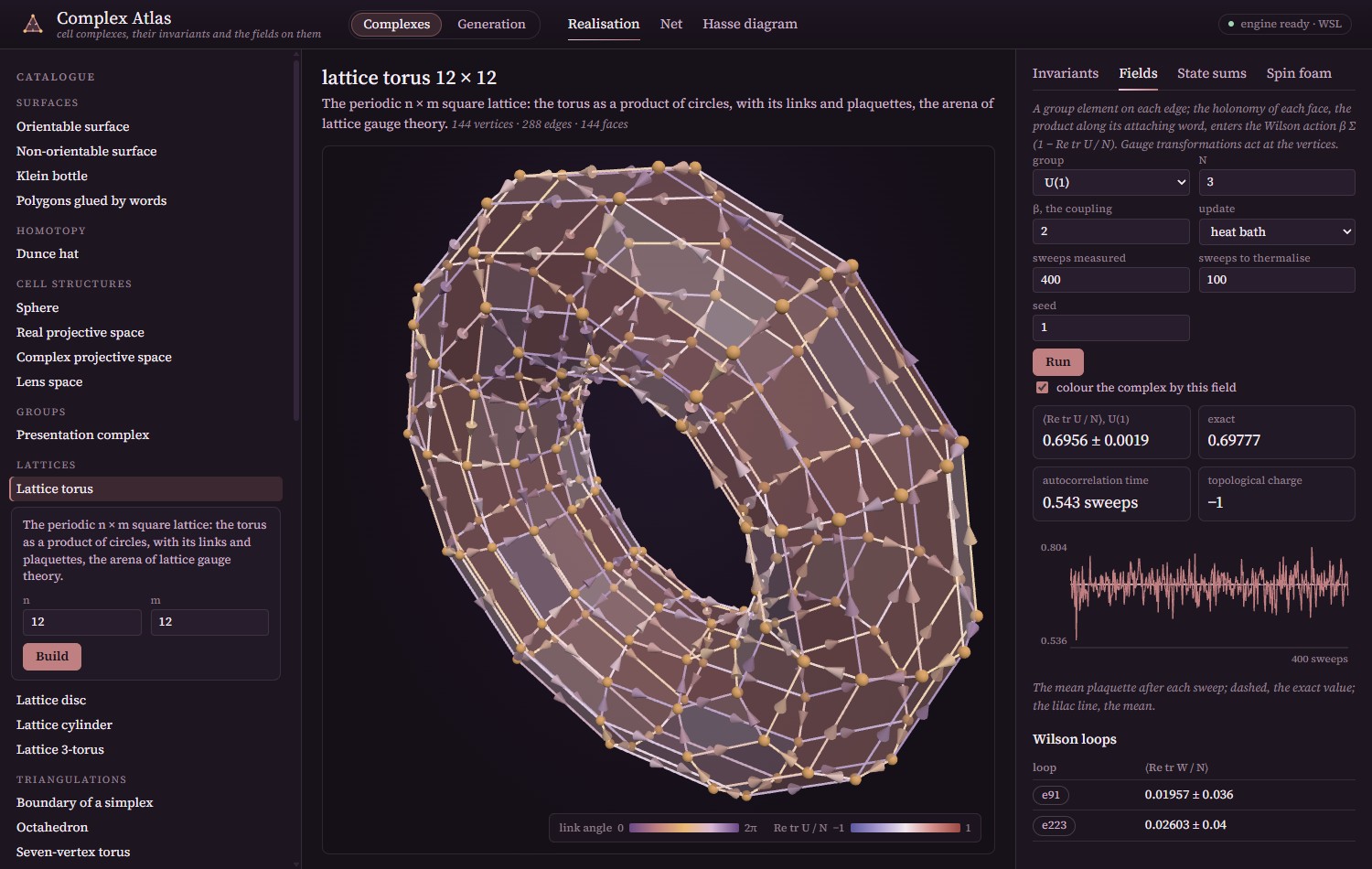
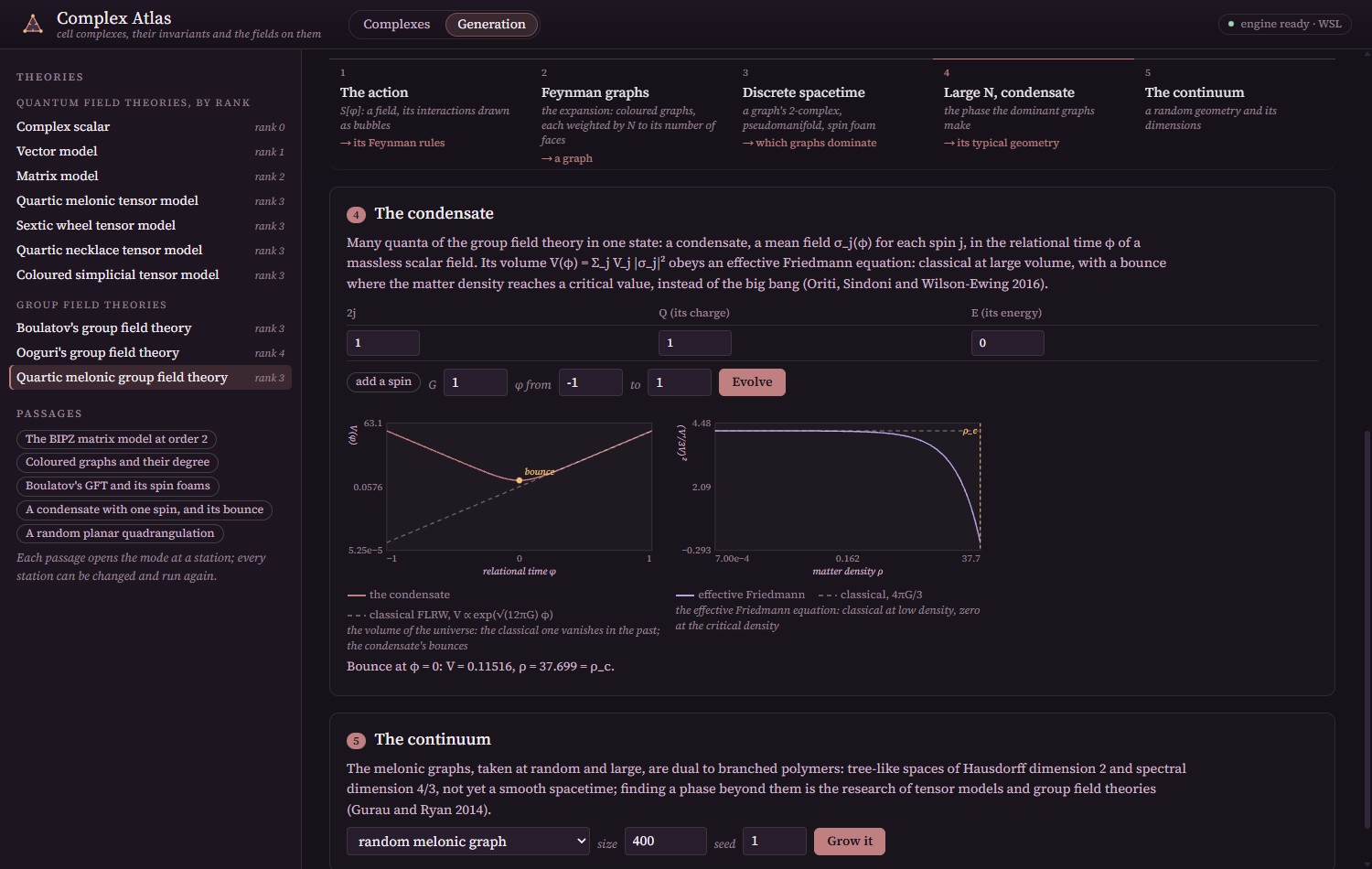
Cell complexes with their exact invariants and the gauge fields on them, and the generation of spacetime by field theories: from an action, through its Feynman graphs and spin foams, to the condensed phase and the continuum.
The History Complex
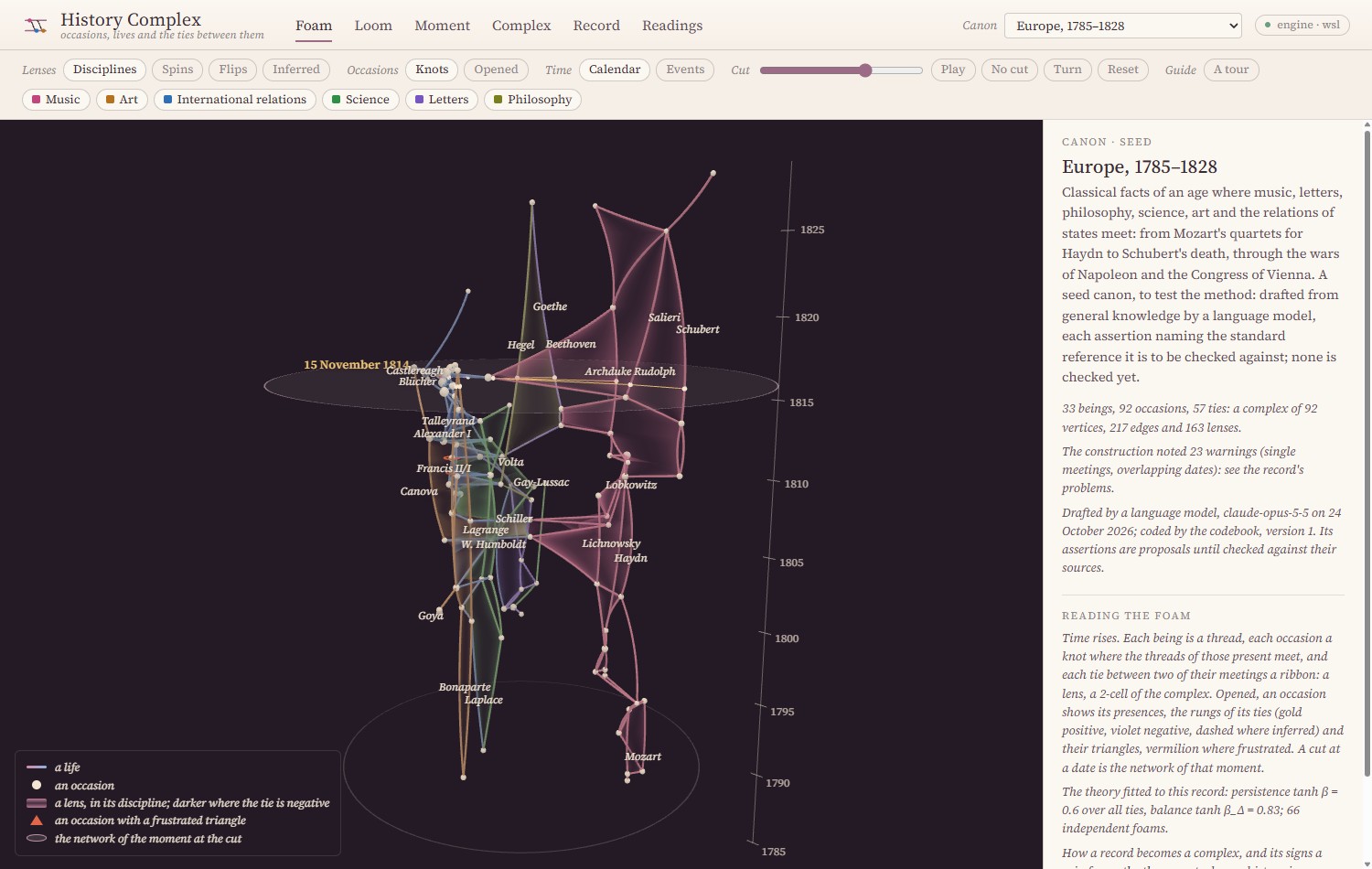
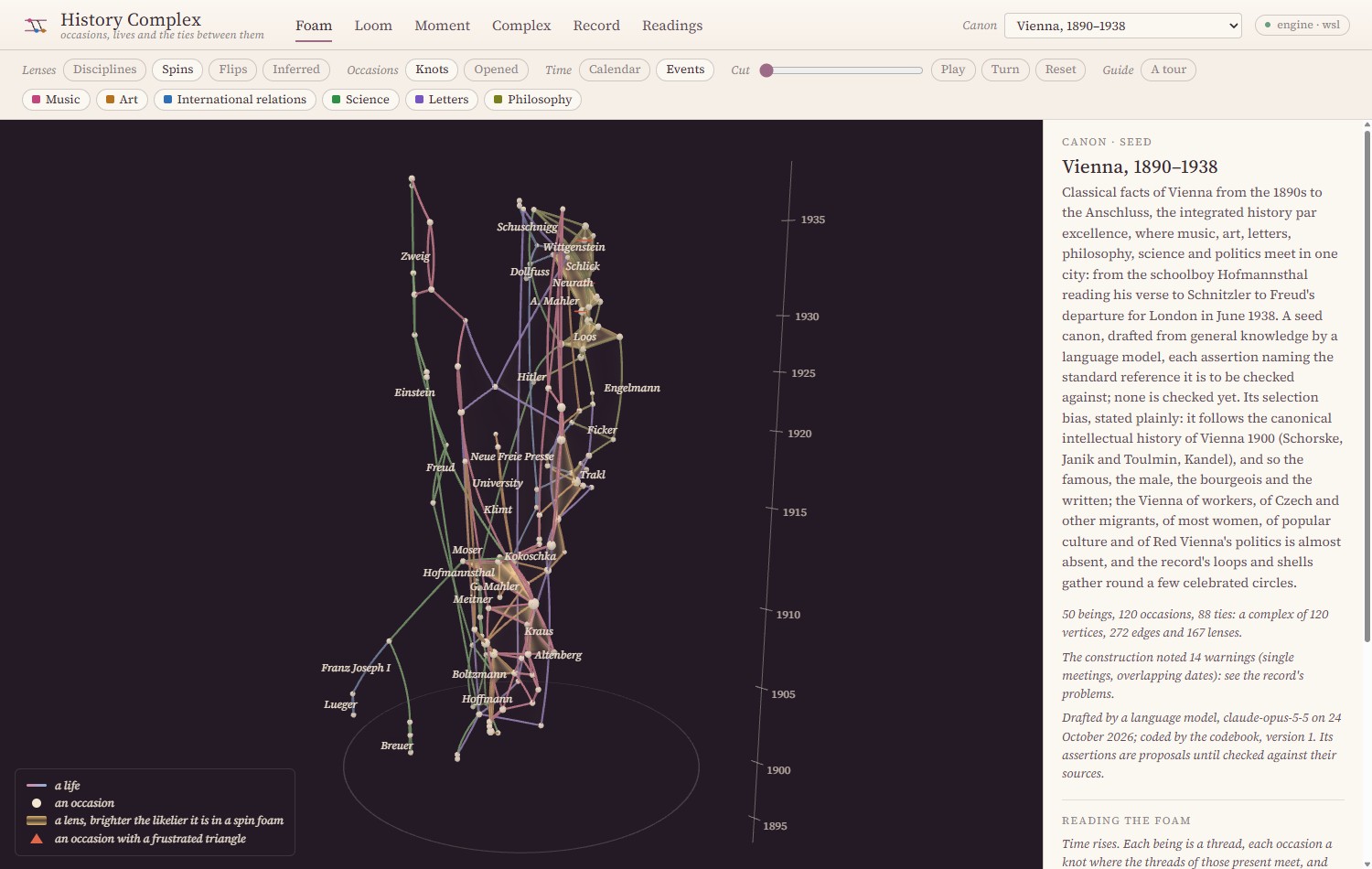
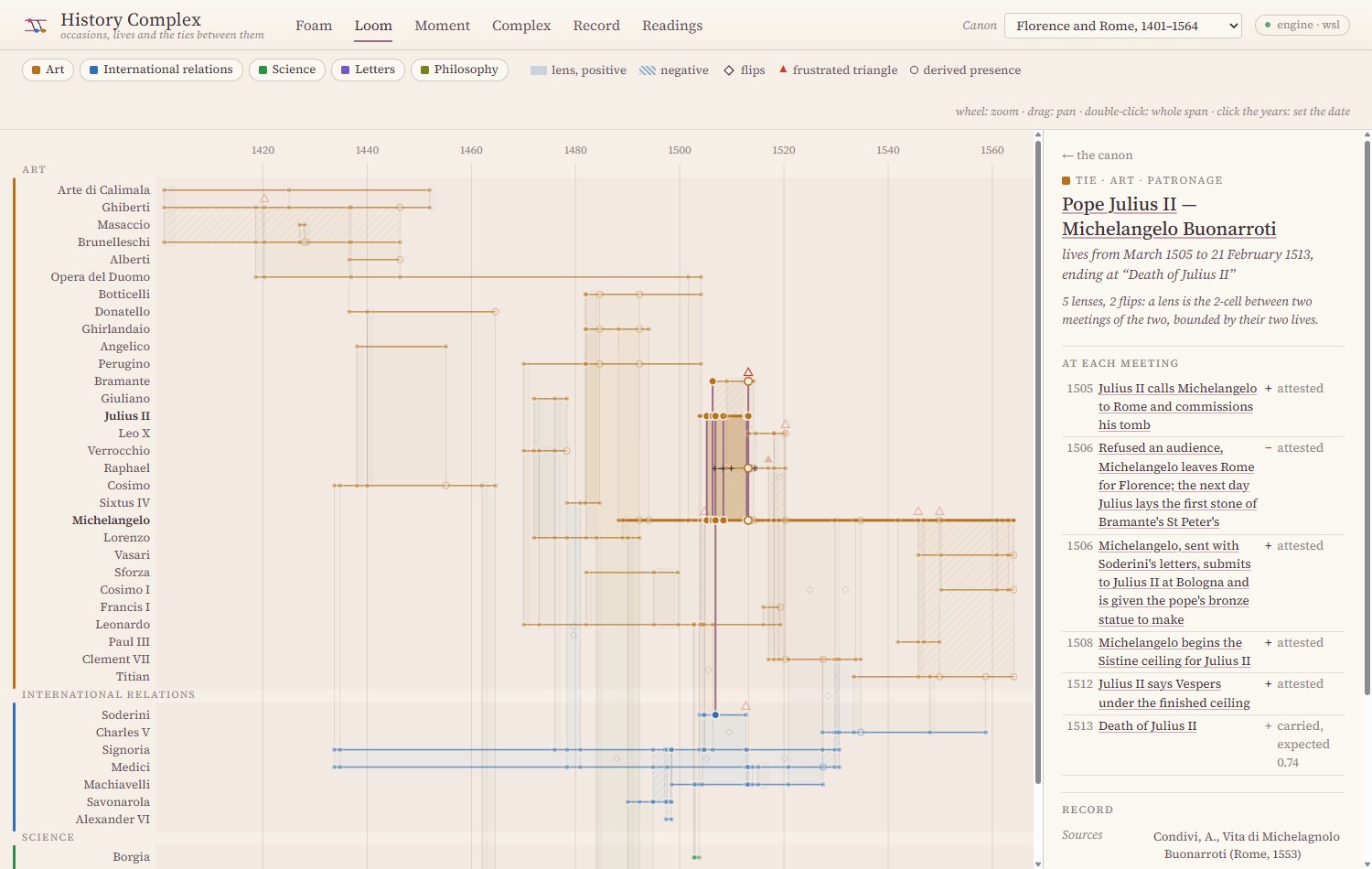
Histories built into 2-complexes: occasions are vertices, the lives of beings edges, and each tie between two beings a 2-cell. Their loops, shells and signed ties are read exactly, the ties as the spin foam of a ℤ₂ gauge theory fitted to the record. Its canons are seeds drafted by a language model and marked unchecked until checked against their sources.
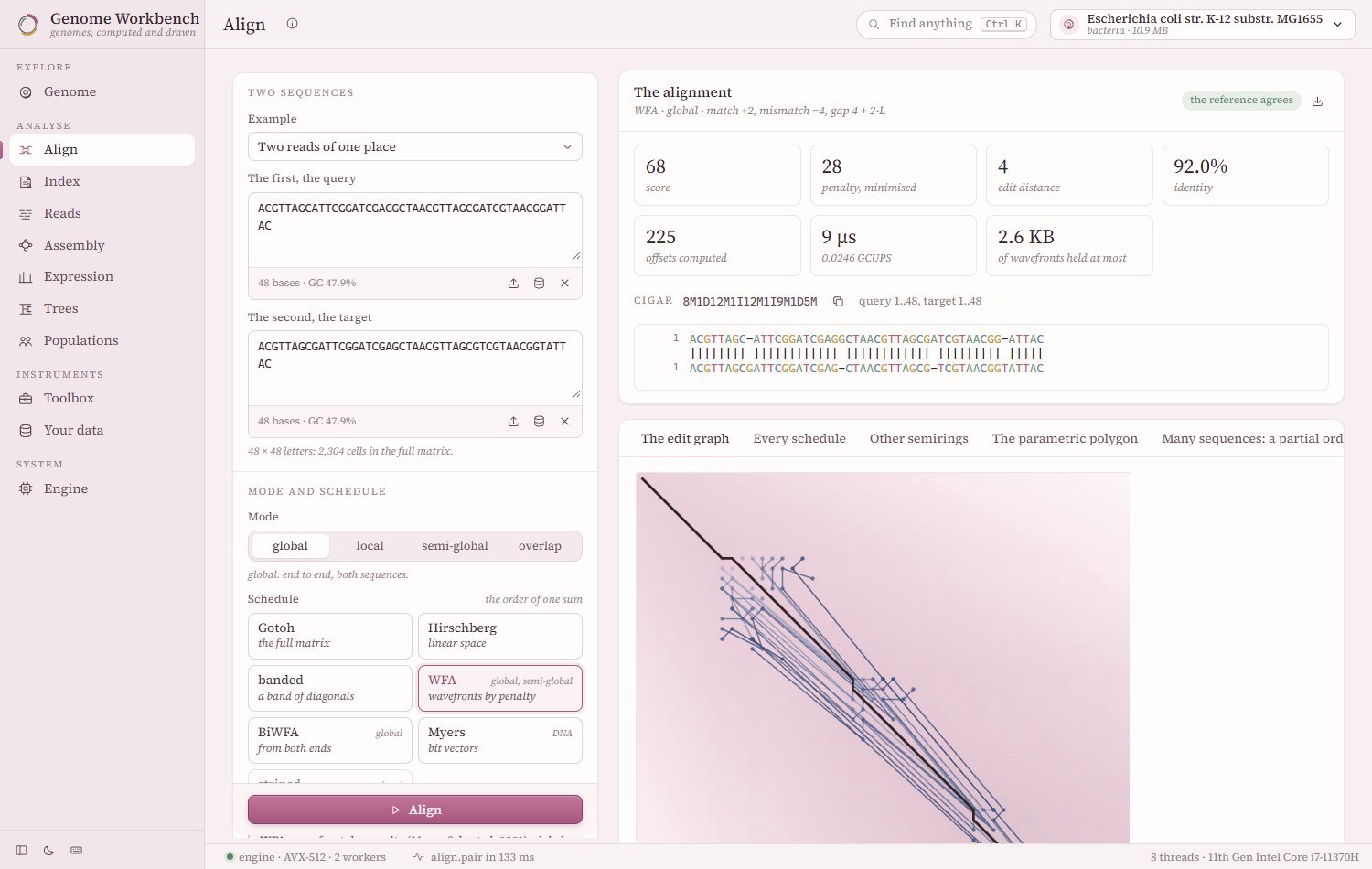
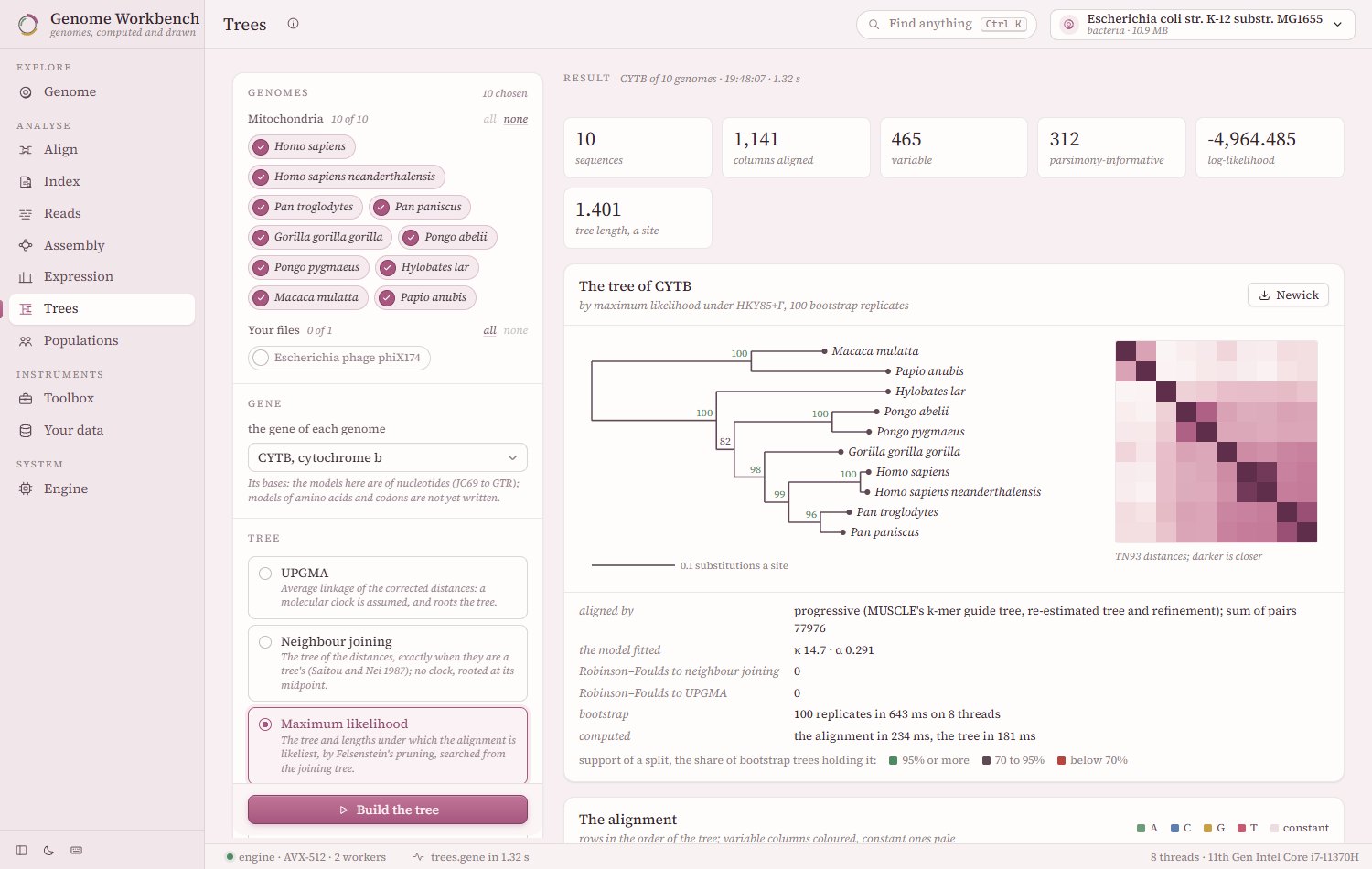
The Genome Workbench
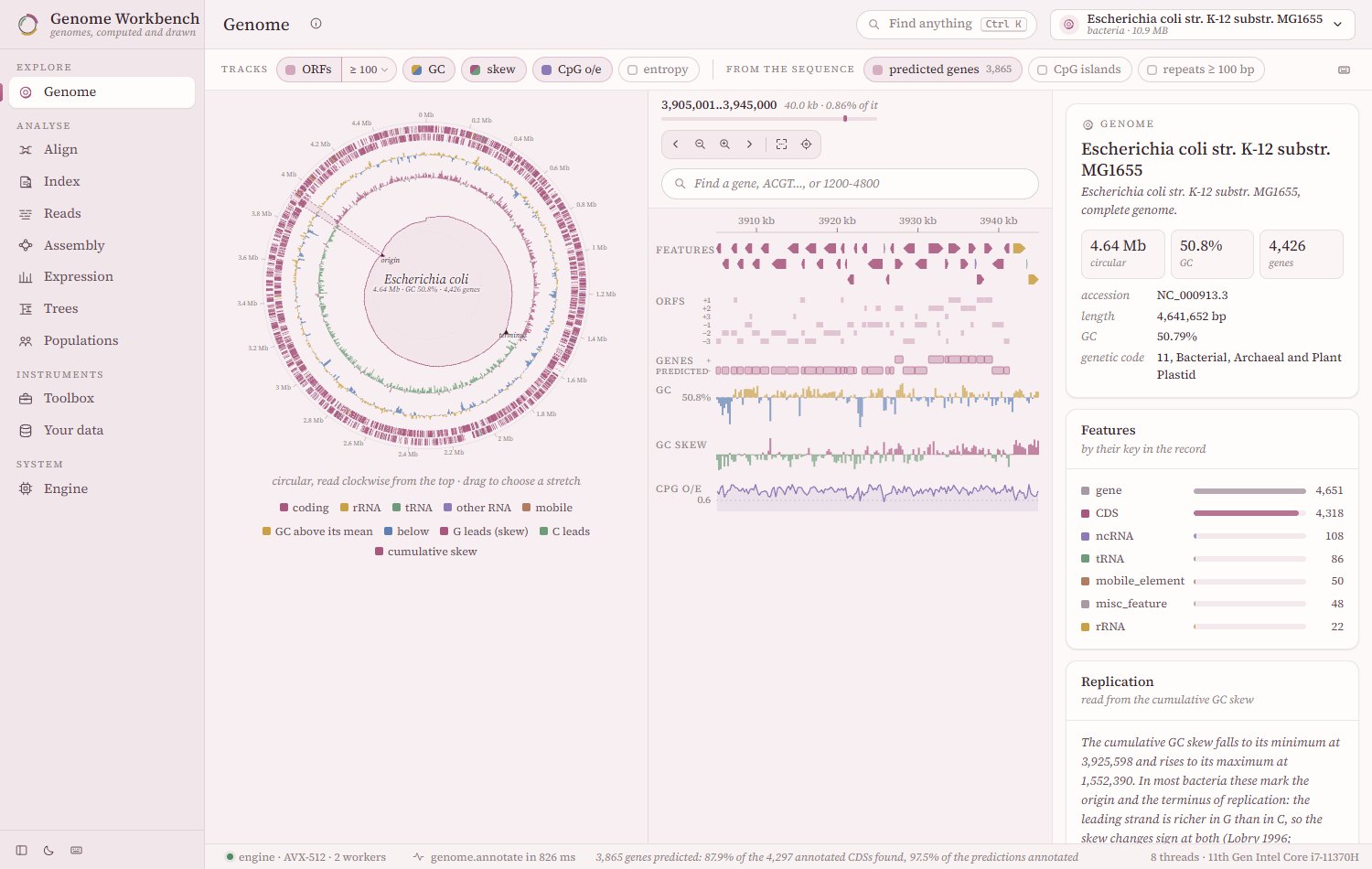
Genomes mapped, aligned, indexed, read, assembled and placed on their trees by a C++ engine on the genomics and evolution domains, with a toolbox of instruments for one's own sequences and files.
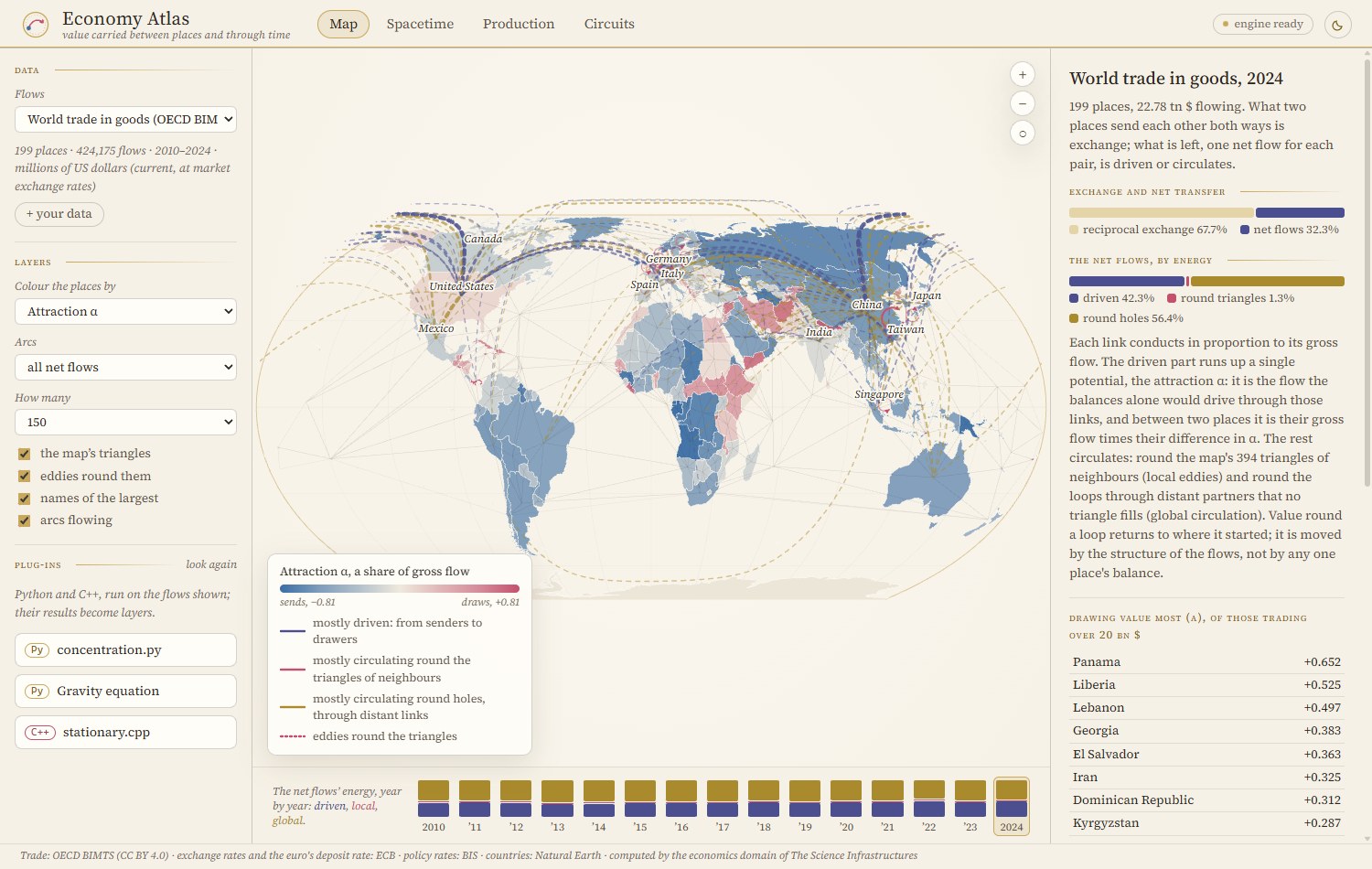
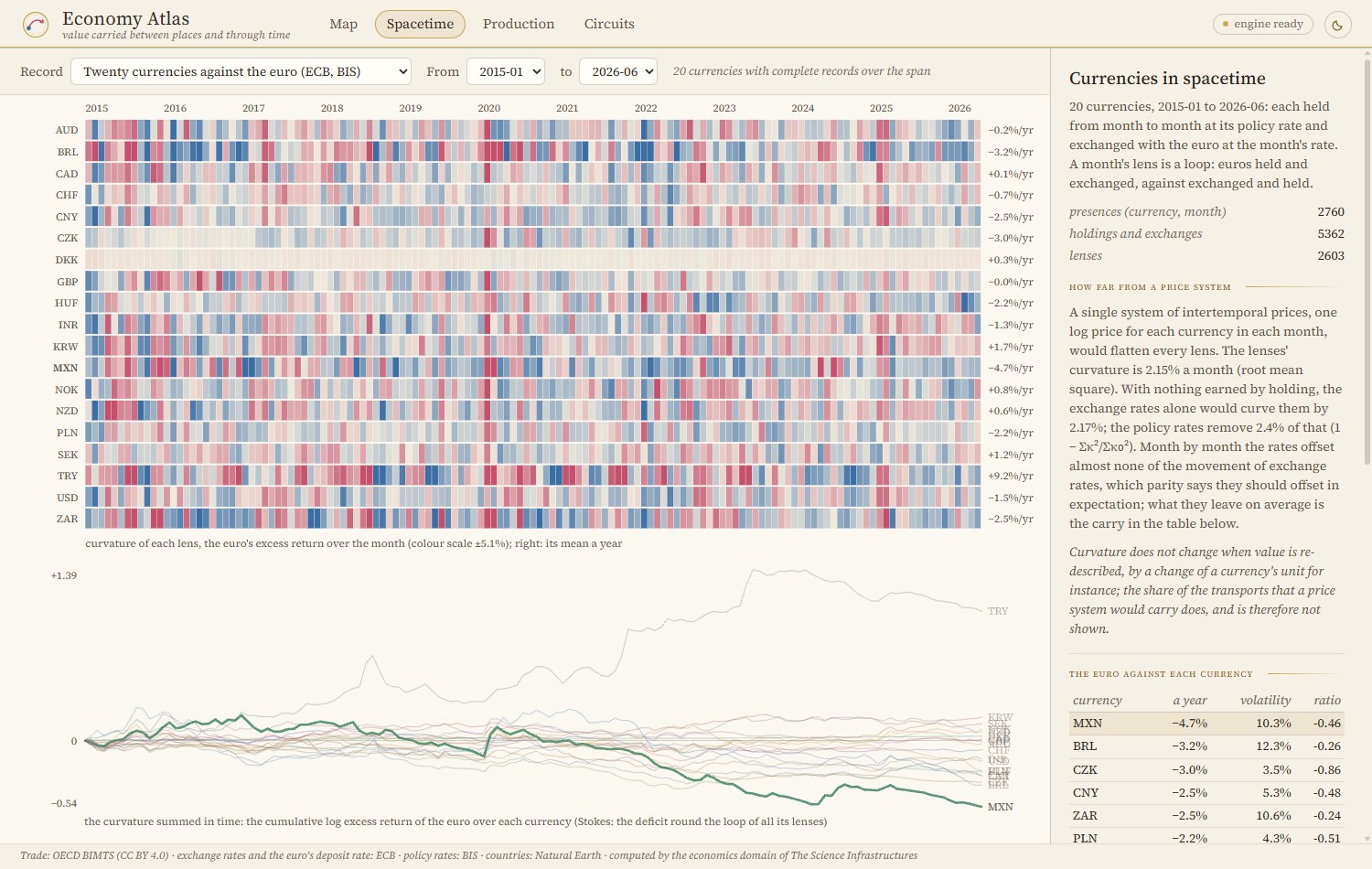
The Economy Atlas
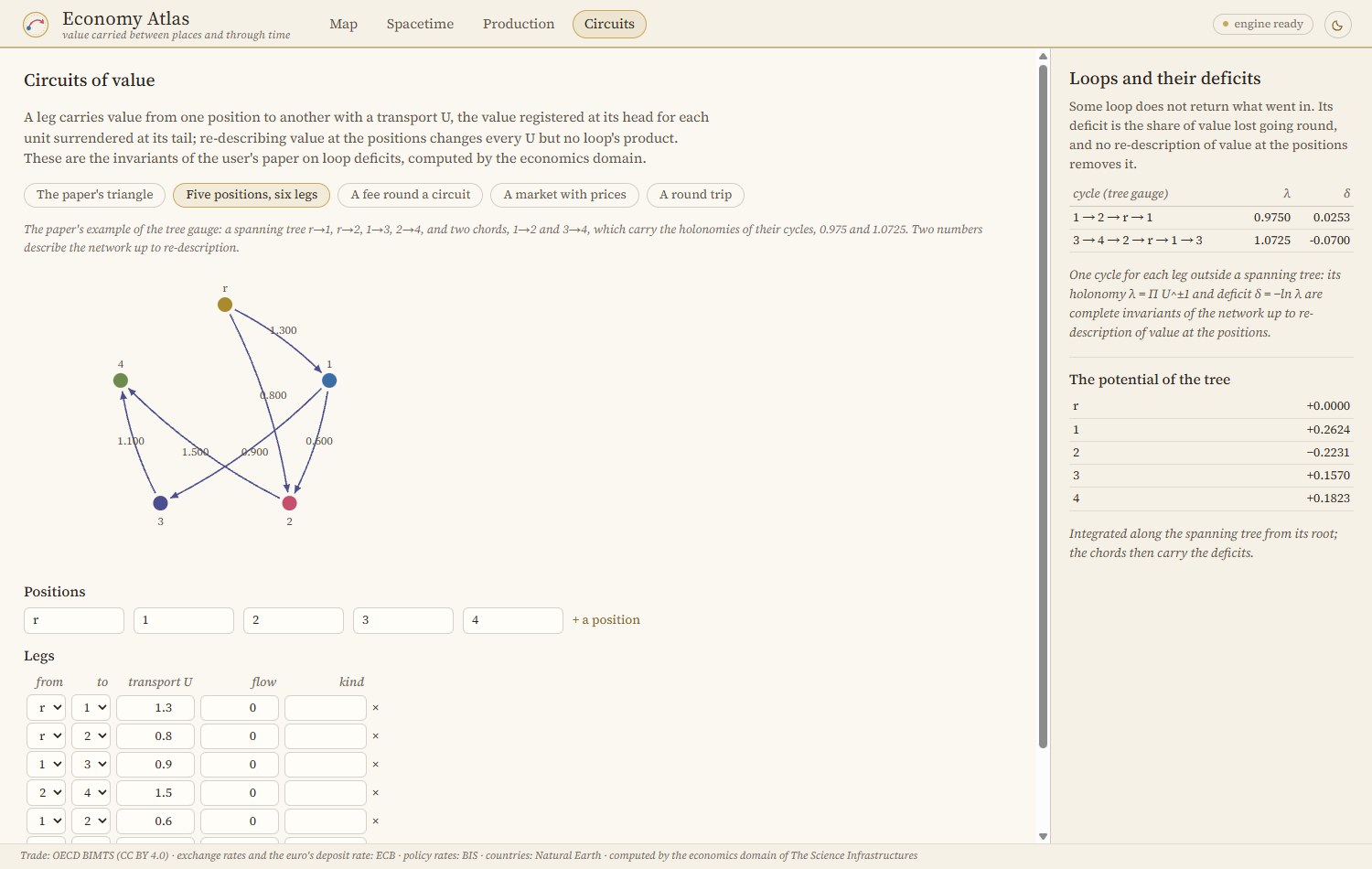
Value carried between places and through time: the world's trade split into exchange, drive and circulation; currencies held and exchanged as a spacetime whose curvature is the departure from interest parity; production as a circular flow; and the loop deficits of transfer networks, which vanish exactly when a system of prices exists.
Cosmopoiesis
A framework for constructing and simulating physical worlds. Its first world is the Solar System, from a crater's floor to the orbit of Pluto, on a console drawn as a precision instrument: its fields drawn in the world, the ground saying where each of its heights comes from, the Earth beneath any place to its centre, and instruments whose every reading says whether it was observed, modelled or assimilated.
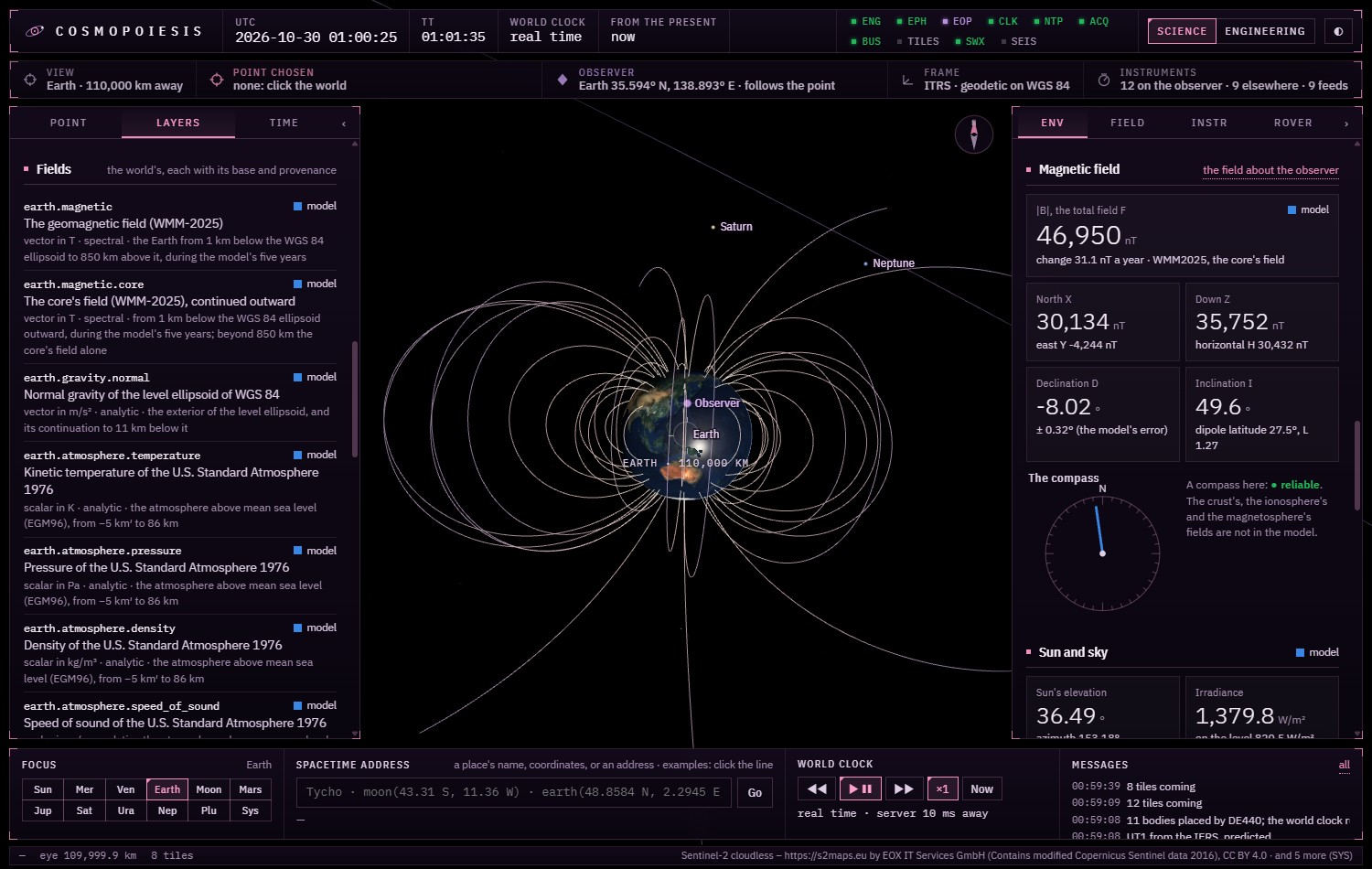
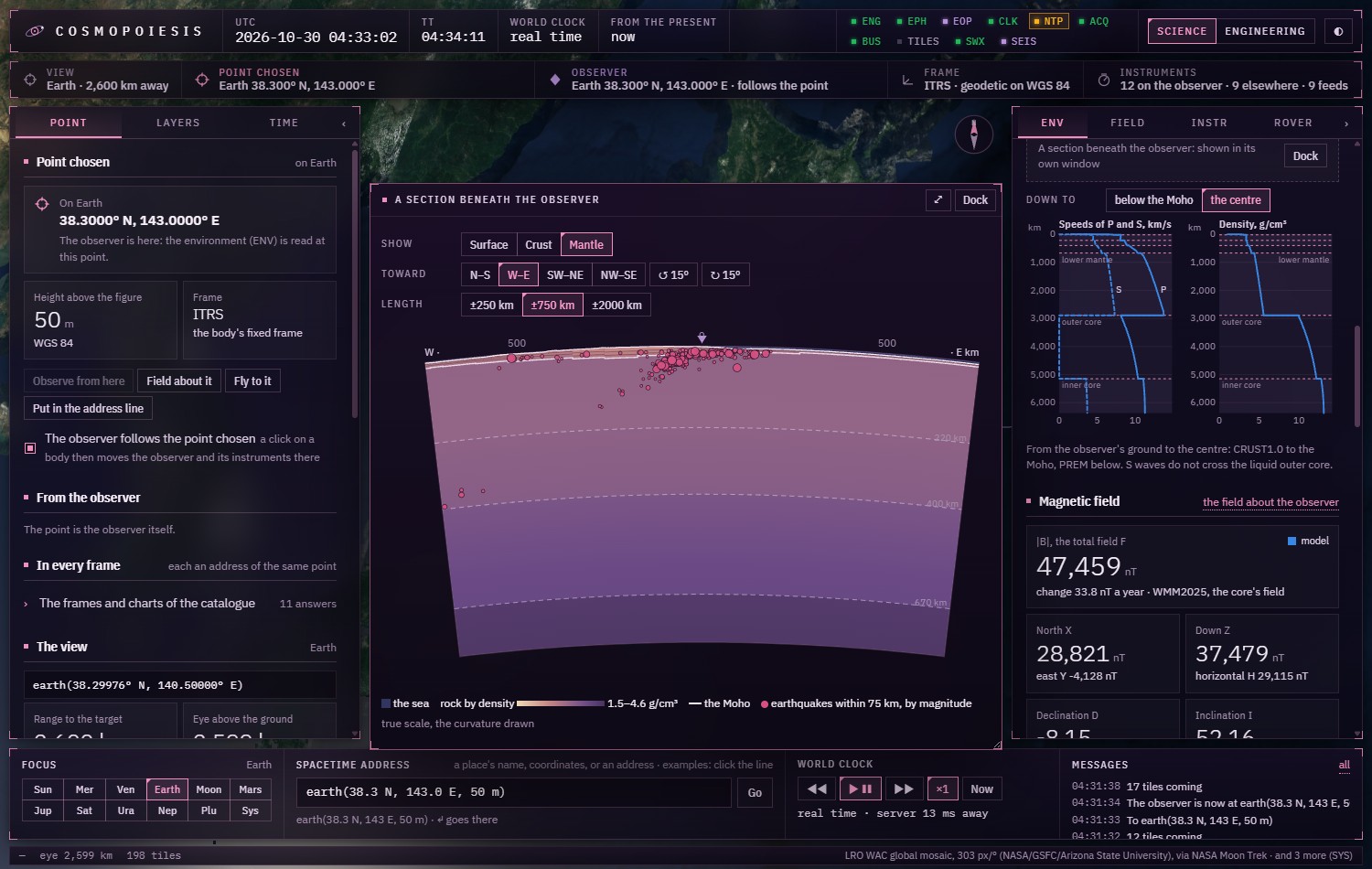
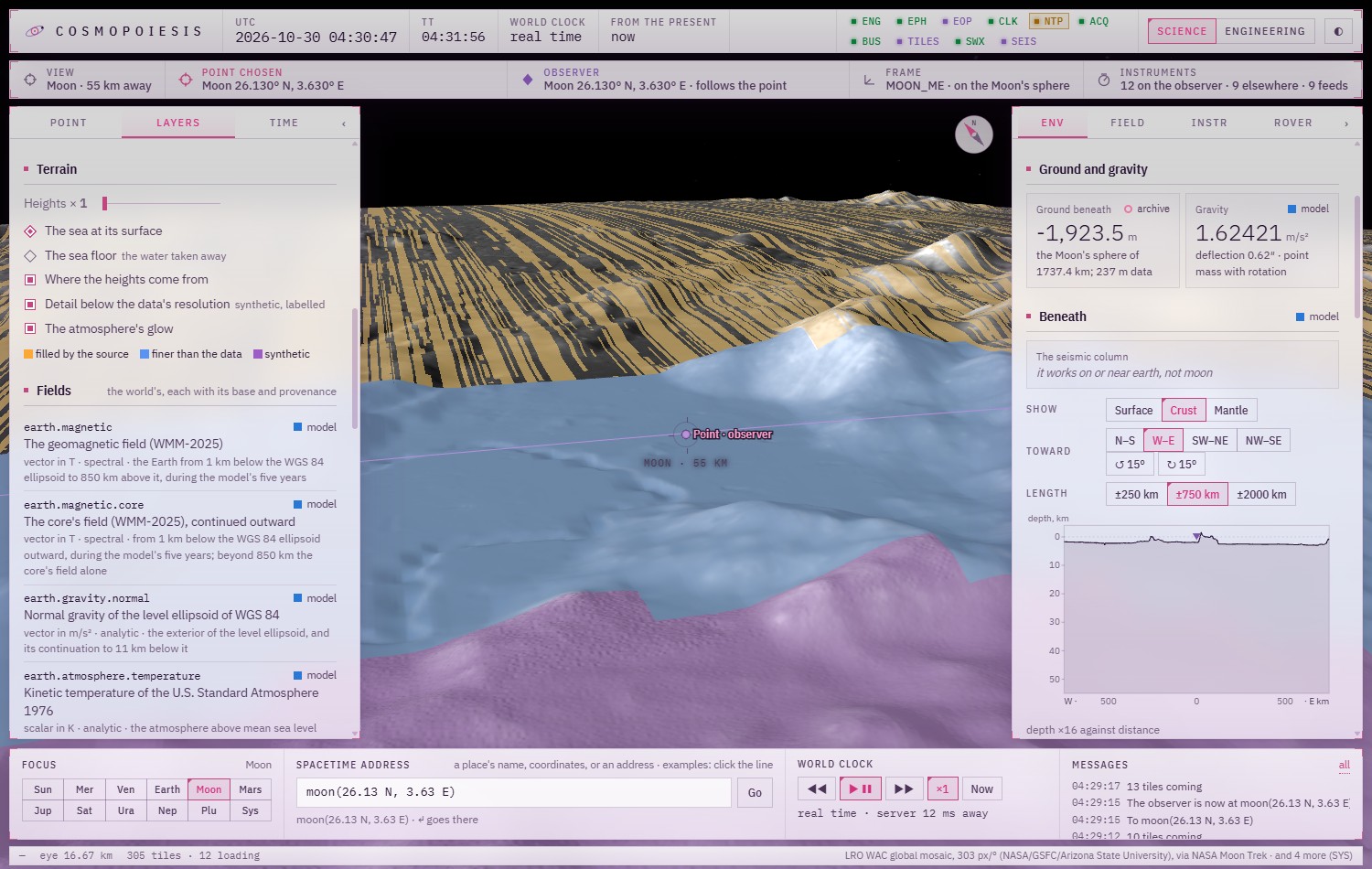
The screenshots are the infrastructure's, under its MIT licence; the data shown in them keep their own licences, listed in the gallery's credits.
Where it stands
As of 30 October 2026, the repository's README records:
The domains of the Earth and the sky are held to SOFA, ERFA, JPL Horizons, NAIF, GeographicLib, PROJ and Vallado's verification set; history, genomics, evolution, economics, planetary science and robotics are C++ from the start; each domain writes no general method of its own, but uses the foundations'. The next steps are set out in the repository's roadmap, and every decision, with its reasons, in its decision log.
Run it yourself
You need Git, Python 3.12 or later and a current browser; nothing else for the three atlases. The first run downloads about 450 MB of public data.
git clone --recurse-submodules https://github.com/huangwanhong-maker/The-Science-Infrastructures.git
cd The-Science-Infrastructures
python3 -m venv .venv
.venv/bin/python -m pip install -r data/requirements.txt
.venv/bin/python data/acquisition/recipe.py applications/earth-atlas/recipe.json
.venv/bin/python applications/earth-atlas/serve.py --open
On Windows, write .venv\Scripts\python. The applications with a C++ engine (the Spiking Simulator, the Complex Atlas, the History Complex, the Genome Workbench, the Economy Atlas and Cosmopoiesis) also need g++, in WSL on Windows. The Quick Start gives every application's lines, and the public instances of the three atlases.
Free to use, free to continue
- Open source. Every repository is released under the MIT License. Anyone may use, study, change, sell and redistribute it, fork it and carry it on, with or without the project and with or without the Society.
- The copyright stays with its makers. Each contributor keeps the copyright in what they contributed. The Society is the project's steward and holds no copyright or other intellectual property in it; it cannot relicense it.
- Contributing. Contributions are made under the same MIT License, to everyone, with a sign-off (
git commit -s) certifying the Developer Certificate of Origin. There is no contributor agreement. Each repository's CONTRIBUTORS.txt holds the terms and the register of contributors. - AI assistance, stated. Much of the code was written with AI coding assistants, and the commits say so. They are recorded as tools; the person who submits the work is its contributor and answers for it.
Governance
Approved by the Founder as SCS/PA/2026/05 (30 October 2026), as sole Director during the Initial Period under §14.5 and §14.6 of the Bylaws, and announced by the notice SCS/NTC/2026/02. Classified under Domain I (Theoretical and Ontological), with Domains VI (Educational) and II (Epistemic) as secondary. Under the Society's Intellectual Property Policy (SCS/POL/2026/01) the Society retains nothing; the technical direction stays with the project's maintainers. Ethics review under §3.5 is not required at the present scope, which involves no human subjects and no personal data; any work with personal data, and the planned work on drug discovery, will be examined before it begins.
Read the Project Approval (PDF) · Read the Notice (PDF) · The project's own record of the decision
⏱ Both instruments are blockchain-timestamped (OpenTimestamps), so their integrity and date can be verified independently of this site: approval proof (.ots) · hash (.sha256); notice proof (.ots) · hash (.sha256). Verify with ots verify project_approval.pdf.ots.